
 Available in GB
Content
- UK Roulette Casinos: Licensing Comes Before the Table
- How Online Live Roulette Fits the Casino Offer
- Roulette Casino Sites and the Slot-Stake Distinction
- Live Roulette Among the UK’s Table Games
- What Makes a Roulette Casino a Defensible Choice
- Deposits, Limits and the Cost of Playing
- Roulette Bonuses: Read the Conditions, Not the Headline
- Free Roulette Play and What It Can Establish
- Winning at Roulette: The Limits of a Betting System
- Lightning Roulette and Other Live Variants
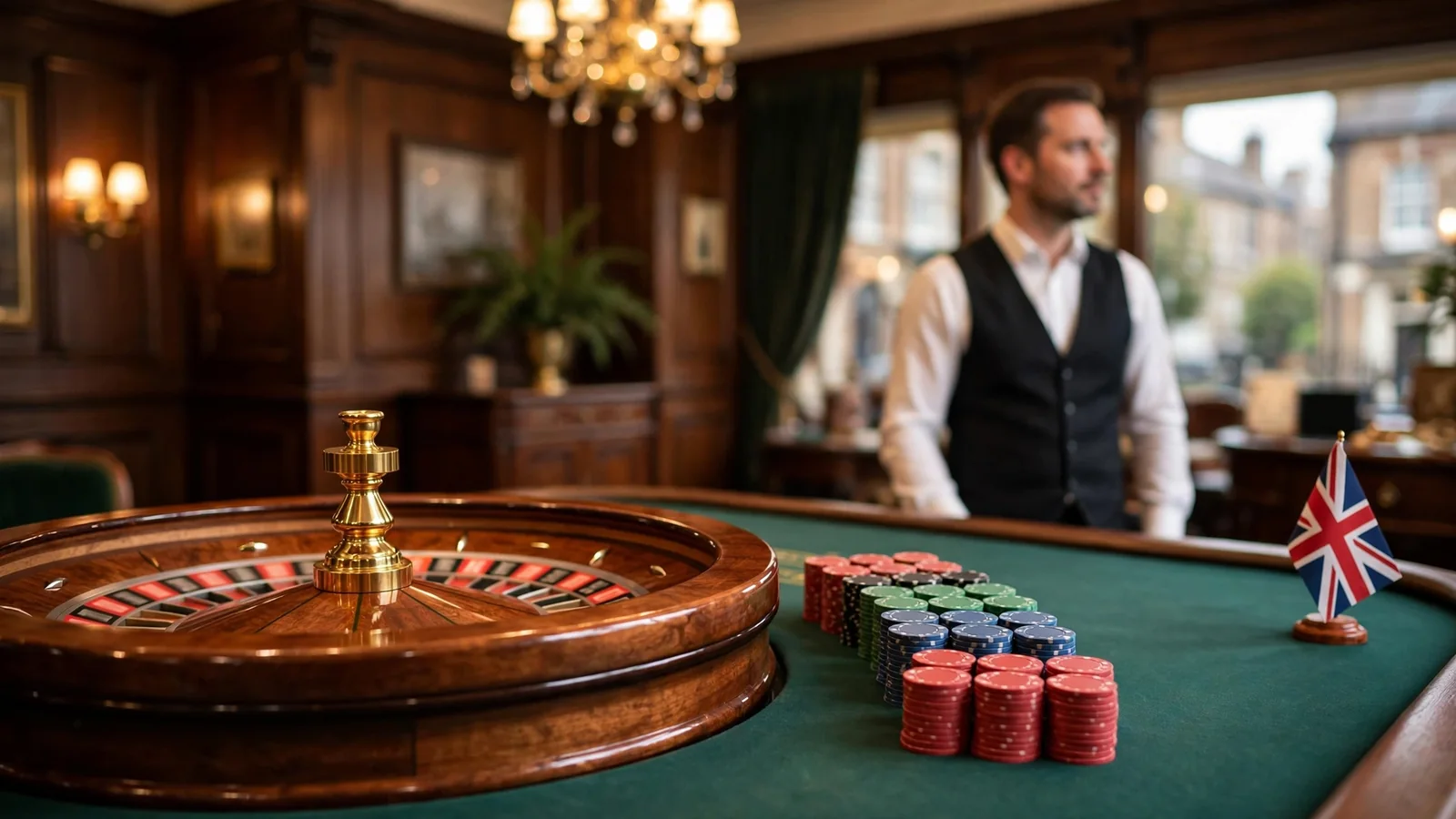
A practical guide to licensing, live-table options, costs, bonus conditions and what roulette systems can—and cannot—show.
UK Roulette Casinos: Licensing Comes Before the Table
A roulette table can be presented as part of a polished online casino, but its appearance does not establish who operates the site or whether that business may legally offer gambling in Great Britain. The relevant first check is regulatory: remote operators serving consumers in Great Britain must hold the appropriate licence from the UK Gambling Commission. That requirement applies whether the operator’s key equipment is in Britain or elsewhere.
The Commission regulates gambling activity in the United Kingdom, including online casinos, and is the sole regulator for commercial gambling in Great Britain. The Gambling Act 2005 governs gambling in England, Wales and Scotland; it does not govern Northern Ireland. For a roulette casino operating in the British market, the central question is therefore whether the business offering the gambling holds the relevant Commission licence.
This is not the same as checking whether a game has a familiar name, whether a website looks professional, or whether a company has a presence elsewhere. A licence is an authorisation issued to a business for regulated activity. The Commission also issues personal licences to individuals who operate in Great Britain, but a personal licence is not a substitute for the operating licence required of a remote gambling business serving the market.
Match the licence to the operator
A useful check starts with the operator’s legal identity and the licence number it gives for its gambling service. Those details should be compared with the UK Gambling Commission’s public register before a deposit is made. The register is the place to establish whether the named business has an operating licence; a badge or licence claim displayed on the casino’s own pages is not independent confirmation.
The name on the register may not be identical to the consumer-facing casino brand. That makes the relationship between the site, its brand and the licensed business important. The stated operator and domain should make sense together, and the register entry should support the claim that the business behind the site is authorised to provide remote gambling to Great Britain consumers. If the details do not align or the licence cannot be confirmed, the licensing question remains unresolved. A roulette table is no reason to treat that gap as immaterial.
Live Baccarat Online Casinos in the UK: Licensing
The Commission’s remit follows the market being served, not the location of the equipment. A remote operator cannot avoid the British licensing requirement simply by hosting its systems abroad. Offshore availability and British regulatory approval are separate matters: a site being reachable does not establish that it is licensed to serve this market.
This distinction matters because a casino may use familiar language about regulation without making clear which entity holds the authorisation. The register check concerns the business actually responsible for the gambling service, rather than a software provider, payment intermediary or another company mentioned on the site. Each may have a role, but that does not by itself demonstrate that the operator holds the required licence.
What the check establishes
A confirmed operating licence establishes that the operator is within the Commission’s licensing system for the relevant activity. It does not turn roulette into a risk-free product, guarantee a particular experience, or settle every question about a casino’s terms. Those are separate assessments. Licensing is the threshold condition: without it, the site has not shown that it is authorised to offer remote gambling to consumers in Great Britain.
The same principle applies whether a site is described as a roulette casino, a general online casino or a live casino. Roulette is still casino gambling; a different presentation does not create an exemption from the operator’s licensing obligation. The table format can be assessed only after the operator’s regulatory status is clear.
The UK Gambling Commission publishes its register at gamblingcommission.gov.uk. Checking the licence number there before depositing is a basic control, not administrative tidying. If the operator cannot be matched to a relevant entry, the sensible decision is not to proceed on the strength of the site’s own wording.
Attention: A badge or licence claim displayed on a casino’s own pages is not independent confirmation; always verify the operator via the UK Gambling Commission’s public register.
Licensing also gives a defined point of accountability. The Commission authorises businesses through operating licences and individuals through personal licences, placing commercial gambling in Great Britain within a formal regulatory framework. That structure is different from relying on a casino’s claims about its own status. The claim can be checked; the register is the reference point.
A UK roulette casino is not established as regulated merely because it accepts British customers, displays sterling, or offers roulette. The meaningful test is whether the business serving Great Britain holds the relevant UK Gambling Commission operating licence. Until that is verified, no deposit should be treated as an ordinary transaction with a confirmed British-licensed operator. And even after verification, roulette remains gambling: only money that can be afforded to lose should be put at risk.
Top online casinos in the UK
- NightWinBonus: £900 + 400 free spins · Payout speed: 1-3 business days
- Revery PlayBonus: 100% up to€1,000+ 100 FS · Payout speed: 1-3 business days
- ZombillionBonus: Welcome Pack 250% up to £4000 + 200 FS · Payout speed: 1-3 business days
- EvoSpinBonus: 125% up to €2500 + 125 Free Spins · Payout speed: 1-3 business days
- JetsetspinsBonus: 200% Bonus + 100 Free Spins + Free Royal Wheel · Payout speed: 1-3 business days
- NightLuckBonus: Welcome Pack + 805% Up To 6400€ + 280 FS · Payout speed: 1-3 business days
How Online Live Roulette Fits the Casino Offer
A live roulette table is an online casino game presented through a real-time video feed, rather than a digital animation standing in for a dealer. That distinction should be visible before a table is opened. A lobby label, table description or game information panel can show whether the game is live; a roulette image or the word “roulette” alone cannot establish that. Where the presentation is unclear, the category name is not enough to make the format clear.
The practical assessment is less about the size of a casino’s game catalogue than about the information attached to each table. A long list can still leave basic questions unanswered: is the selected table genuinely live, is the dealer speaking English, and can those details be found before the game loads? Clear labels reduce the chance of entering a table on an assumption that the page did not support.
Mines Casino Game in the UK: Demos and Play
Check what “live” describes
Casino menus may place live games alongside automated games, or group both under a general roulette heading. The distinction matters because the live format depends on a streamed dealer presentation. The table page should make that status explicit, not leave it to inference from a photograph, a provider logo or a “live casino” banner elsewhere on the site.
A useful check is to follow the route from the casino lobby to the individual table. If “live” appears only as a broad menu heading, the table’s own information should still confirm its format. Conversely, an individual table description that clearly identifies a live dealer gives more useful evidence than a general promotional panel. The point is not to infer production quality from labels, but to establish what kind of game is being offered.
Descriptions should also be consistent. If the lobby calls a table live but its information panel describes an automated game, the mismatch is material. A player should not need to resolve conflicting labels after entering the game. The more consequential detail belongs beside the table itself, where it can be checked before access.
Read the dealer-language label precisely
For a search focused on live roulette with English-speaking dealers, “English” needs to describe the dealer’s spoken language, not merely the casino website, game controls or customer-service channel. Those are separate features. A site may present menus in English while offering a table whose dealer speaks another language; an English-language help desk does not settle the table question either.
For live roulette, the language label must describe the dealer’s spoken language, not the website’s interface or customer service channels.
Dealer-language information is most useful when attached to the specific table. A general statement that a casino operates in English may not say whether every live roulette table has an English-speaking dealer. If the lobby provides language filters or table labels, those can help narrow the selection, but the selected table’s details should confirm what the filter means. An unclear label is not a reliable substitute for a clear description.
The distinction is especially relevant where several tables appear under the same game name. A player may see similar titles and assume the language is shared across them. That assumption has no value unless the table listing makes it explicit. The relevant information is the dealer’s spoken language for the particular table, not a broad description of the casino’s intended market.
Check access before treating a table as available
A table shown in a lobby is not necessarily immediately usable in every browser or on every device. The game page can reveal whether it loads as expected, whether the video is visible and whether the controls remain legible alongside the stream. These are access checks, not judgements about the roulette rules or a promise that a particular casino will provide a specific technical experience.
The route into the table is also part of the offer. A clear lobby should let the user identify live roulette without relying on unrelated categories or promotional tiles. Once selected, the table page should retain enough information to confirm its identity and language. If the label disappears on entry, or the table opens without a clear indication of its format, the earlier information has not carried through cleanly.
Live Dream Catcher Casino UK: Checks Before Playing
Compare information, not catalogue size
When comparing an online casino with roulette, the useful questions are concrete: does the individual listing identify the game as live; does it state the dealer’s language; and does the table page preserve those details? A concise, consistent description can be more informative than a large catalogue whose categories blur live and automated games.
A short check can therefore separate presentation from assumption. The lobby establishes how the casino categorises the table. The table description establishes whether it is live and what language the dealer uses. The game page confirms whether the selected table matches that description. If any link in that chain is vague, the uncertainty should be treated as unresolved rather than filled in by a logo or a general claim about the site.
The table’s accessibility is only one part of the overall casino decision, but it is the part that determines whether the stated live-roulette provision is intelligible before play. Roulette should be treated as a cost of entertainment, not a source of income; only money that can be afforded to lose should be wagered.
Roulette Casino Sites and the Slot-Stake Distinction
A stake cap attached to an online slot should not be read as a limit for every game on a casino site. In Great Britain, the figures reported in a specialist review apply to online slots: the stated maximum is £5 for a game cycle when the customer is aged 25 or over, and £2 when the customer is aged 18 to 24. The same review distinguishes roulette and blackjack from slots, saying those slot limits do not apply to either table game.
Stake Limits
Online slot stake caps (£5 for 25+ and £2 for 18-24) do not apply to roulette or blackjack table games.
That distinction matters when checking a roulette casino site. A casino may offer slots and roulette through the same account, but sharing a lobby does not make the games subject to the same stake rule. The amount allowed on a slot spin cannot, by itself, establish what can be placed on a roulette wager. Conversely, a roulette table’s stated conditions should not be treated as evidence that a slot stake cap has changed.
The relevant question is what kind of game is being played. A slot has a game cycle; roulette is a table game with wagers placed on the outcome of a spin. The regulatory figures above are expressly described as slot limits, while the review says they exclude roulette. Treating the slot amount as a universal casino ceiling would therefore mix up two categories. It would also give a misleading basis for comparing roulette casino sites in the UK.
What the distinction does—and does not—tell you
The exclusion does not establish a standard roulette stake, nor does it tell a player how much any particular table will accept. Table conditions can be presented separately from the slot controls, so the relevant information is the roulette table’s own terms and displayed limits. The distinction is narrow: it prevents a slot-specific cap from being misapplied to roulette. It is not a statement that roulette has no limits.
Online Casino Without ID in the UK: What It Means
This is useful when comparing a live roulette casino site with a wider casino offer. A lobby may place slot games beside roulette tables, and a general account page may describe controls that apply to particular products. The game label and its own conditions matter more than the fact that both products sit under one casino brand. A slot stake figure is not a substitute for checking the roulette table information.
The same care applies to descriptions of the “best” or “top” roulette casino sites. A comparison based on the slot cap alone would not rank roulette provision or identify a table’s terms. It would only repeat a rule belonging to another game category. For a live table, the stated wager conditions are the material detail; slot limits should remain in the slot column of any comparison.
For customers aged 18 to 24, the lower slot figure does not become a roulette limit merely because the same account offers both products. For customers aged 25 and over, the higher slot figure likewise does not set a roulette ceiling. Age is relevant to the figures described for slots, but those figures still concern slot play. The category does not change when games share a site.
These figures are attributed to a specialist review, rather than presented here as a complete account of every current rule. Its stated distinction is nonetheless clear: the described Great Britain slot caps concern slots, not roulette or blackjack. Roulette wagers should therefore be assessed against the table’s own displayed conditions, not inferred from a slot rule. Gambling can result in losses; only money affordable to lose should be wagered.
Slot vs Roulette
- Slot stake caps are specific to game cycles and do not set a ceiling for roulette wagers.
- Roulette table limits are separate and should be checked on the table’s own terms.
- Age-based slot limits do not translate into universal casino ceilings for table games.
Live Roulette Among the UK’s Table Games
Live roulette sits within a wider category of casino table games presented with a dealer on screen. It shares that setting with card games such as blackjack and poker, but the experience is not interchangeable: the game, table layout and information shown alongside the broadcast determine what is being compared. A useful comparison starts with those practical differences, not with a broad label such as “live casino”.
Grosvenor’s history offers a concrete example of how this category developed in the UK. The operator first unveiled live casino games in 2013, with a selection that included Blackjack, Texas Hold’em and Roulette. The mix matters because it places roulette among several live formats rather than treating it as the whole table-game offer. A casino’s live lobby may therefore contain games that share a dealer-led presentation but have different rules, layouts and ways of participating.
For roulette, the first useful distinction is the table format and the rules attached to it. A listing should make clear which version is offered and provide access to its rules before play. The name alone is not a full description. If two tables are presented as roulette, their published information should be checked side by side rather than assumed to be identical. The same applies to any extra wager or feature shown on the table: its conditions belong to that particular game, not to roulette in general.
Online European Roulette in the UK: Rules and Play
Other details help establish whether a table suits a player’s preferences:
- Dealer language: clear labelling matters where spoken instructions and interaction form part of the presentation.
- Table limits: the minimum and maximum wager indicate the financial range the table permits. They should be read before joining, not inferred from another table in the same lobby.
- Rules and wager options: the table’s own rules explain what is available and how its layout is organised.
- Presentation and interface: the screen should make the wheel, betting area and relevant information legible. A live broadcast does not remove the need to understand the controls.
- Game format: the description should distinguish a standard table from a named variant, with the relevant rules available for that specific option.
These details also make comparisons across table games more useful. A roulette table can be compared with another roulette table on its own stated terms; comparing it with blackjack or poker requires a different question, because the games do not use the same rules or wager structure. “Live” describes the presentation, not a common set of game conditions.
A casino’s catalogue is consequently more informative when it shows the particulars of each table rather than relying on category labels. A broad “table games” heading identifies the section of the lobby; it does not establish whether a particular roulette game is suitable, what wagers it permits or which language its dealer uses. Those points need to be visible at the table level.
The cost of a session remains a separate decision from the format. Table limits set the permitted range, not a recommended spend or an expected return. Roulette outcomes are uncertain, and no table presentation changes that. Only money that can be afforded to lose should be put at risk.
Live Table Check
- Verify the game is explicitly labeled as “live”.
- Confirm the dealer’s spoken language.
- Review the table’s minimum and maximum wager limits.
- Read the specific rules and wager options for the game variant.
- Ensure the interface is legible on your device.
What Makes a Roulette Casino a Defensible Choice
“Best” is not a useful verdict without a standard behind it. A defensible choice is one that can be checked against clear conditions: the operator’s status, the information shown before a wager, and the quality of the account’s practical protections. A polished roulette lobby is presentation, not evidence.
The first check is the operator’s entry on the UK Gambling Commission’s public register. The licence number should match the operator and the service being used, rather than merely appearing somewhere on a page. The register is the point of reference before depositing; a logo or a statement that a casino is licensed does not perform the same check.
A dated example shows why the match matters. An affiliate review reported that the Commission’s public register, checked on 26 September 2026, did not show a LuckyPays entry under the brand or its stated domain, including luckypays.io. That finding is specific to the register check and its date; it should not be turned into a general claim about other operators or treated as a substitute for checking the current register.
The table itself should disclose the information needed to understand the offer before play begins. That includes the roulette format, the applicable table rules and the maximum wager accepted. A headline about favourable odds is not enough: the relevant comparison is between the stated terms of the actual table, not a broad claim about the casino. If key conditions are difficult to locate, the practical value of the offer is difficult to assess as well.
American Roulette Casinos Online in the UK: Licence Checks
For live roulette, dealer-language details should be explicit where they are relevant to the table. A casino may offer several formats, but the name of a game or a live label does not establish which language a dealer uses. Clear table information reduces the chance of choosing on an assumption; it does not change the underlying terms of the game.
Account protections are also part of the decision standard. A UK-licensed casino must provide responsible-gambling tools, including self-exclusion, and a route for complaints, with access to an approved Alternative Dispute Resolution service. These are not decorative policy pages: they define what recourse and controls exist if an account issue arises.
The same standard applies whether assessing a casino described as the best for roulette or comparing live tables. Licence verification, readable table conditions and usable safeguards are checkable. Rankings and claims of superior odds are not substitutes for them. Roulette remains gambling, not a reliable source of income; only money affordable to lose should be wagered.
Deposits, Limits and the Cost of Playing
The cost of playing roulette online is not set by the table alone. Account conditions determine when money can be deposited, which funding methods are permitted and what controls are available to limit spending. These checks apply whether the intended session is at a live table or another casino game.
Age verification must take place before an operator allows a customer to deposit funds into a gambling account. An account that has not cleared that check is not ready for real-money play. For roulette, as for other online gambling, the minimum age is 18, and the operator must verify age before accepting a deposit.
Do
- Complete age verification before depositing.
- Set a financial limit before the first deposit.
- Use funding methods that avoid credit cards.
Don’t
- Deposit funds before setting a spending limit.
- Use credit-card funding for gambling.
- Assume a payment method is acceptable without checking its source.
Before a new customer makes a first deposit, the operator must prompt them to set a financial limit. Account-level limit controls must also remain accessible, so a customer can review or adjust limits without having to search through unrelated account settings. These controls are relevant to the amount exposed to gambling, not a forecast of likely losses or a measure of whether a session will be profitable.
A limit has practical value only if it is set before funds are committed and reflects money that can be lost without affecting essential costs. A roulette casino may make its tables available promptly, but the speed of access does not alter the financial decision. Gambling should be limited to money that can be afforded to lose.
Payment restrictions also affect the available balance. Remote gambling operators cannot accept credit-card payments for gambling, including credit-card funding routed through a money service business. The restriction also covers wallet payments where the wallet permits credit-card funds to be used for gambling. A payment method appearing in an account menu is not, by itself, evidence that every source of money behind it is acceptable.
For someone planning to play roulette at a UK casino, the useful account check is therefore practical: age verification completed, a financial limit set before the first deposit, limit controls accessible, and a funding method that does not use credit-card money for gambling. If any of those conditions is unclear, depositing first and checking later reverses the sensible order. The financial exposure begins when funds are committed, not when a session feels serious.
Roulette Bonuses: Read the Conditions, Not the Headline
A roulette promotion has a stated value, but that figure alone does not show what the offer is worth in practice. The terms determine which games qualify, how the bonus can be used, whether winnings are restricted and when the promotion expires. Without those details, a welcome bonus or deposit offer is a headline, not a usable calculation.
For a roulette casino bonus, the first check is game eligibility. Casino promotions may apply to selected games or categories, and roulette may be excluded or count differently from other play. Where live roulette is involved, the terms should make clear whether live tables qualify. A promotion described broadly as a casino bonus does not establish that a particular roulette table is eligible.
Next, separate bonus funds from withdrawable cash. Check whether wagering conditions apply to the bonus, to the deposit, or to both, and which games contribute towards those conditions. The relevant figure is not the advertised amount in isolation; it is the amount that must be wagered under the stated rules before any resulting balance can be withdrawn. If the terms do not explain how roulette contributes, the offer cannot be assessed on the assumption that every roulette wager counts in full.
A roulette casino welcome bonus and a later deposit bonus may have different conditions, even when their promotional language sounds similar. Read the rules attached to the specific offer, including any expiry date, maximum conversion or withdrawal conditions, and restrictions on simultaneous promotions. These are not minor details: each can reduce the practical value or prevent the bonus from being used as expected.
How to evaluate roulette bonuses
Check for game eligibility to ensure live roulette tables qualify. Separate bonus funds from cash and determine the specific wagering requirements that must be met before withdrawal. Finally, verify expiry dates and any restrictions on simultaneous promotions.
A no-deposit promotion also needs its own assessment. The absence of a required deposit does not, by itself, mean that winnings are immediately withdrawable or that roulette play qualifies. The terms still determine eligible games, wagering requirements and withdrawal conditions. The same applies to a live casino promotion or an offer mentioning Lightning Roulette: the named game should appear in the eligibility rules, not merely in promotional copy.
A sound comparison records the stated bonus, the qualifying roulette games, the wagering basis, the time limit and the withdrawal conditions. If any of those terms are unclear, the value remains uncertain. Promotional wording is packaging; the conditions determine the amount that can actually be used.
Free Roulette Play and What It Can Establish
Free roulette can be useful for checking whether a game’s layout is understandable before money is involved. If a casino offers a no-stake mode, it can show where the wager controls sit, how selections appear on the table and where the game displays its rules. That is a practical test of the interface, not evidence that funded play will feel identical.
Availability should be checked on the casino’s own game page. A search for free roulette in the UK may lead to casino pages, game listings or promotional material, but none of those alone confirms that a particular table can be played without a stake. The distinction matters: a demo option, if present, is not the same as a bonus balance or a funded account.
What a no-stake mode can show
The displayed rules can be read before choosing a table. For French roulette, the relevant check is the actual rules and paytable shown for that game, rather than an assumption that every version with the same name works identically. The same applies to a free casino roulette game: its screen may help establish how wagers are placed and how outcomes are presented, but it cannot establish the terms of a different table.
A displayed casino roulette edge is not a guarantee about an individual result. It is a feature of the game’s rules and payout structure, so a demo can help identify what information the operator provides, but it does not demonstrate future returns. If the rules or payout details are unclear, the game has not passed the information check.
A free version of Fireball Roulette, where offered, should be treated in the same limited way: inspect the on-screen instructions and conditions for that specific version. The name alone does not establish which rules apply or whether a no-stake mode is available.
Free play also cannot confirm the payment conditions, account controls or experience of wagering real funds. It removes the financial stake from the practice session; it does not turn the session into a forecast. Nor does familiarity with the interface change the uncertainty of roulette outcomes.
For a useful comparison, note whether the game is genuinely presented as free, whether its rules are accessible before play and whether the table’s layout is clear enough to follow. Do not treat a practice balance as money available to withdraw. Any later funded play remains a separate financial decision, and only money affordable to lose should be wagered.
Caution: No betting system can remove the uncertainty of roulette outcomes or guarantee a profit; past spins do not forecast future results.
Winning at Roulette: The Limits of a Betting System
A roulette system can organise wagers; it cannot turn an uncertain game into a dependable source of income. A staking pattern may specify when to increase, reduce or stop a wager, but it does not control which outcome appears. That distinction matters more than the name attached to the system.
Progression systems are often presented as a route back to profit after a loss. In practice, raising a later wager increases the amount exposed to the next result; it does not make that result more likely. A winning sequence can also be followed by losses, while a run of losses does not establish that a win is due. Past spins provide no reliable forecast of the next one in a properly operating game.
The same limit applies to strategies built around colour, number groups or a target return. They can define how a player behaves, but cannot remove the uncertainty in each spin or guarantee a final balance. A plan to stop after a chosen result is a limit on exposure, not a method for changing the odds. No betting system can make roulette profitable every time, whether the table is online, electronic or presented by a live dealer.
A more useful calculation starts with the amount that can be lost without affecting essential spending. Set that sum as a ceiling, and treat it as the cost of playing rather than money expected to return. A session target does not make a target attainable; extending play to recover losses only puts more funds at risk.
The practical test of a system is therefore not whether it promises a win, but whether its staking rules remain affordable through losing results. If following the pattern requires wagers beyond the planned ceiling, the system has failed its only controllable test. Stop rather than increasing exposure to chase an outcome. Roulette can produce a winning session, but no sequence of choices guarantees one. Gamble only with money that can be afforded to lose.
Online Casino Tournaments UK: Formats and Rules
Lightning Roulette and Other Live Variants
Lightning Roulette is a named live roulette variant, but the title alone does not establish how a particular casino presents or governs the game. The operator’s table information is the useful reference: it should identify the game as live, set out its rules and explain any variant-specific terms before play begins. If those details are not available before a wager is placed, the cost of uncertainty falls on the player.
The same check applies when a casino groups Lightning Roulette with its live casino games. A product label does not confirm that a table is currently available, that its rules match another version, or that a dealer speaks English. Dealer-language information should be stated separately; it should not be inferred from the game’s name or a casino’s general description.
“Lightning Roulette slots” is also an imprecise label. Lightning Roulette is identified as a roulette product, not a slot. Slot search results or casino menus do not change the game category, and the applicable rules should be taken from the specific table listing.
Casino scores and promotional descriptions are not substitutes for game terms. Before play, check the rules, the conditions attached to any special features and the stated wagering limits for that table. Compare those terms with the amount intended to be risked; an attractive presentation has no accounting value if the conditions are unclear.
The same standard applies to other live variants: verify the rules for the named game rather than assuming that a familiar roulette label means identical terms. A variant changes the product being offered, not the basic need to understand its conditions. Only gamble what can be afforded to lose.
What are the online slot stake limits in Great Britain?
The limit is £5 per game cycle for adults aged 25 and over, and £2 for adults aged 18 to 24. These limits do not apply to roulette or blackjack.
Are online casino games licensed and regulated?
Yes. Remote casino operators serving consumers in Great Britain must hold the relevant UK Gambling Commission licence, regardless of where their equipment is located.
Is LuckyPays licensed by the UK Gambling Commission?
The Commission’s public register does not show an entry for LuckyPays or its stated domain, luckypays.io, so a UK Gambling Commission licence for the brand cannot be confirmed.
How do I verify that a non-GamStop roulette site is safe and fair?
Check the UK Gambling Commission’s public register for the operator’s legal name and licence, and confirm that the entry supports its claim to serve Great Britain. A licence confirms regulatory authorisation, but does not by itself guarantee a particular experience or settle every question about a casino’s terms.