
 Available in GB
Content
- What Makes a Live Blackjack Casino a UK Option
- Assessing Casino Terms Without a Best-Casino List
- Live Dealers, Tables and the Casino Floor
- How Casino Blackjack Works—and What Winning Depends On
- Blackjack Variants Beside the Live Tables
- Playing Blackjack Online: Account Checks and Deposits
- Blackjack Strategy Starts With the Cost of Risk
- A 2026 Check on Live Blackjack Casino Claims
- Blackjack Bonuses: Calculate the Conditions Before the Headline
- Blackjack Rules, Stakes and the Slot-Limit Distinction
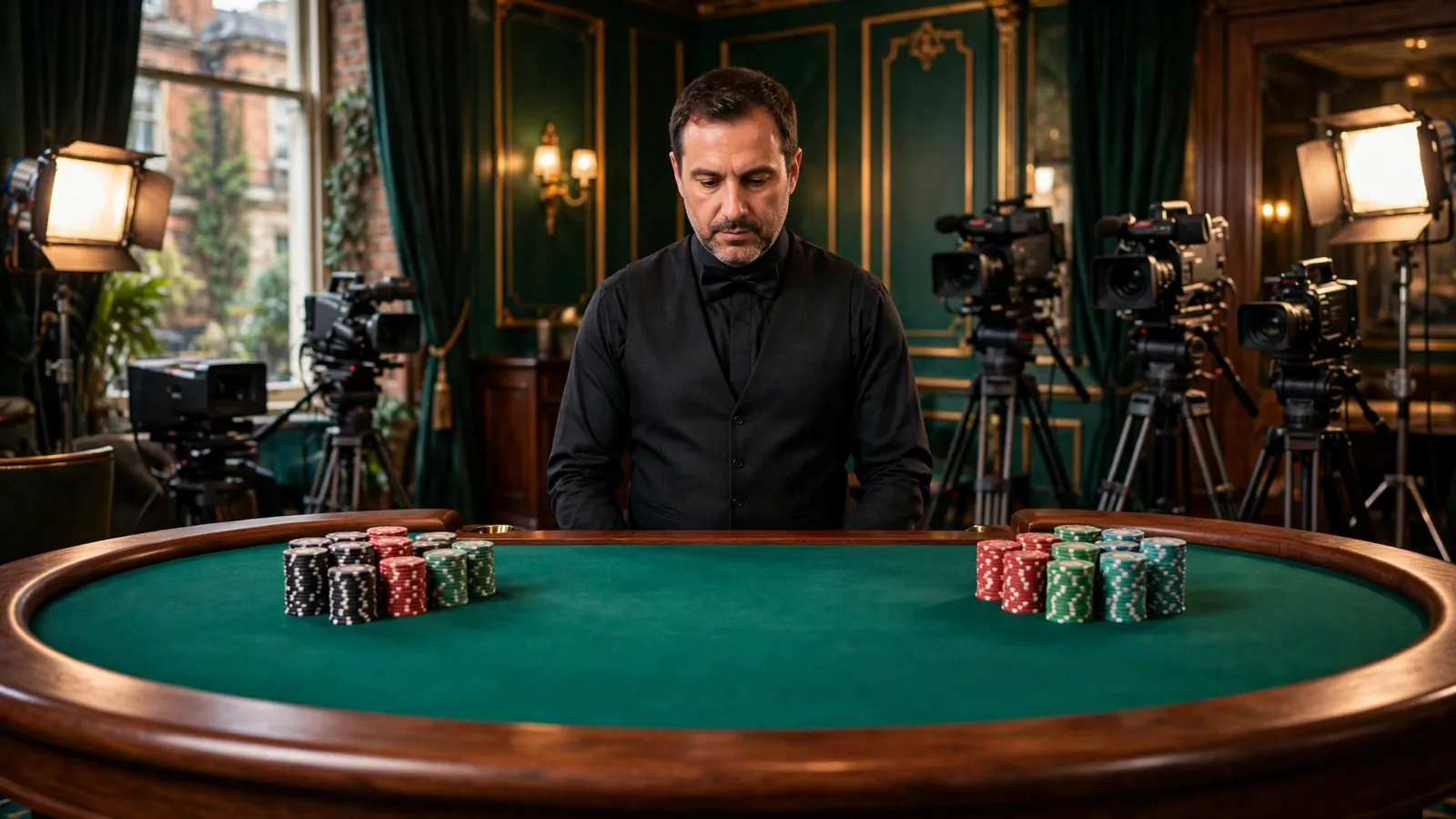
A practical guide to UK licensing, live tables, blackjack rules, deposits, risk and bonus conditions—without ranking casinos.
What Makes a Live Blackjack Casino a UK Option
A live blackjack table may be streamed from a studio far from the player, but the studio’s location does not determine whether the service is authorised for Great Britain. The relevant question is whether the operator holds the required Gambling Commission licence to offer remote gambling to people in that market. The Commission’s oversight extends to remote services offered to Great Britain consumers even when the equipment running them is elsewhere.
That distinction matters because a casino’s website can look local without being licensed to serve the market. A British-facing name, pounds shown on a page or a live dealer speaking English does not establish regulatory status. Those are presentation choices. The licence is the legal basis for offering the gambling service.
The UK Gambling Commission regulates gambling activity across the United Kingdom, including online casinos. In Great Britain, it is the public authority responsible for commercial gambling regulation. Its role is not limited to physical venues: remote gambling is also within its remit, including online casino games such as live blackjack.
What the licence applies to
Licensing applies to the business offering the gambling service, not just to the software or the table visible on screen. The Commission grants operating licences to businesses and personal licences to individuals whose roles in the industry require one. These are distinct forms of authorisation: a personal licence does not replace the operating licence needed by the company providing the casino.
For a player considering a live blackjack casino, the operator’s identity therefore matters. A site may use a brand that differs from the legal business name behind it. The relevant check is whether the business named as responsible for the service has the appropriate authorisation to provide remote gambling in Great Britain. A provider supplying the game is not, by that fact alone, the casino operator responsible for the customer account.
Live Baccarat Online Casinos in the UK: Licensing
The same principle applies when a casino has a polished live-games section or a familiar dealer format. The broadcast can be technically convincing while leaving the operator’s status unanswered. Licensing is a separate question from how the table looks, what games appear in its lobby or which company supplies the stream.
Scope across borders
A common source of confusion is the location of the equipment. Remote services rely on servers, studios and other infrastructure that may be based in different places. For Great Britain, the decisive point is that the service is offered to consumers there; moving the key equipment abroad does not remove the licensing requirement.
This makes the relevant jurisdiction the market being served, not the address of the live studio. A casino cannot establish permission to offer blackjack in Great Britain merely by showing that its games are produced elsewhere or that a company is registered abroad. The operator must hold the appropriate Gambling Commission authorisation for the activity it offers to local consumers.
The terms “UK” and “Great Britain” should not be treated as interchangeable in every legal context. The Commission regulates gambling in the United Kingdom, while the specific requirement for remote operators described here concerns consumers in Great Britain. For a live blackjack service aimed at that market, the practical standard is clear: the operator needs the relevant Commission licence.
A check before money is committed
Before an account is funded, the operator’s licence should be checked against the Gambling Commission’s public register. The check should connect the site or brand to the licensed business responsible for it, rather than stop at a logo or a general statement that the casino is regulated. If the site’s legal operator cannot be matched clearly to the register, its appearance is not a substitute for that match.
The register is a way to verify an authorisation, not a guarantee that every part of a casino’s presentation is suitable or that every table will meet an individual preference. It answers a narrower and more important first question: whether the business is authorised to offer the gambling service in Great Britain. Other matters, including account conditions and the details of a particular live table, require separate consideration.
Licence Verification
- Identify the legal business name responsible for the casino service
- Locate the operator’s licence number
- Check the number against the Gambling Commission’s public register
- Confirm the registered business matches the site or brand
Licensing also sets a boundary between an operator subject to domestic oversight and one outside that system. A business serving Great Britain consumers remotely cannot avoid the local requirement simply because it operates from another country. A claim of overseas regulation, on its own, does not establish permission to serve the British market.
A live blackjack casino is therefore a UK option in the regulatory sense only when the business offering it is authorised for the market. The dealer, studio and game interface may be the visible parts; the operator’s status is the condition that makes the service lawful to offer locally. The financial rule remains simple: gamble only what can be afforded to lose.
Top online casinos in the UK
- NightWinBonus: £900 + 400 free spins · Payout speed: 1-3 business days
- Revery PlayBonus: 100% up to€1,000+ 100 FS · Payout speed: 1-3 business days
- ZombillionBonus: Welcome Pack 250% up to £4000 + 200 FS · Payout speed: 1-3 business days
- EvoSpinBonus: 125% up to €2500 + 125 Free Spins · Payout speed: 1-3 business days
- JetsetspinsBonus: 200% Bonus + 100 Free Spins + Free Royal Wheel · Payout speed: 1-3 business days
- NightLuckBonus: Welcome Pack + 805% Up To 6400€ + 280 FS · Payout speed: 1-3 business days
Assessing Casino Terms Without a Best-Casino List
A casino cannot be called the best choice for blackjack on a headline or a short feature list alone. The useful comparison is between the written terms and the conditions that apply to the account: which rules govern play, what can change, how a withdrawal is handled, and what happens if the operator restricts access.
The first check is whether the published terms are complete enough to assess. An operator may place general account conditions in one document and game-specific rules elsewhere. Both matter. The general terms describe the relationship between the account holder and the casino; the blackjack rules describe the conditions attached to the game. A review that quotes only a welcome page or a promotional summary leaves out the material needed to judge the offer.
Keno Casinos in the UK: Picks, Stakes and Payouts
Read the account terms as a contract
Account conditions should make clear how an account is opened, maintained, restricted and closed. The wording should explain what information the operator may request, how it handles discrepancies, and what steps it may take if account details cannot be confirmed. Broad statements such as “we may suspend an account” are not enough on their own to show how that power is used. The surrounding clauses should set out the stated grounds and the process that follows.
The terms also need to explain what happens to funds if an account is restricted or closed. That includes how a balance is reviewed, whether outstanding transactions are completed, and how the operator communicates its decision. A clause that gives the operator discretion without explaining the treatment of money leaves a material uncertainty. That uncertainty should be recorded as such, not translated into an assumption that the outcome will favour the customer.
Payment wording deserves the same attention. The terms should identify which payment methods are accepted, how deposits and withdrawals are processed, and whether the account name must match the payment method. Any stated charges, processing conditions or verification requirements affect the amount and timing of money available. Where the documents do not specify a point, there is no basis for assigning it a convenient value.
Separate game terms from promotional language
A blackjack page may describe a game as live, popular or easy to access. Those labels do not establish the applicable rules. The relevant game information should identify the table’s rules and any conditions that affect participation, while the account terms should explain how a player’s activity is recorded and settled. These are separate questions, and a polished game page does not answer both.
Do
- Read both general account conditions and game-specific rules
- Verify the exact eligibility and expiry conditions of a bonus
- Check for conflicts between promotional summaries and full terms
Don’t
- Rely on a welcome page or promotional summary alone
- Assume the outcome of discretionary account restrictions
- Calculate bonus value based on a banner headline alone
Promotional claims should be assessed against the terms that control them. The key details are eligibility, qualifying activity, excluded games, any expiry condition and what happens to funds if the conditions are not met. A large headline has no standalone value if the associated requirements make the resulting balance difficult to use or withdraw. The arithmetic is simple: value depends on what can actually be retained and accessed, not the most prominent number on a page.
That calculation should not be completed from a banner alone. The promotion’s own terms may incorporate general account rules or reserve the operator’s right to amend or withdraw an offer. The wording should be checked for the version that applies to the account and for any condition that changes the amount ultimately available. If the terms are unclear or conflict with the promotional summary, the difference is part of the assessment.
Treat licensing as a separate threshold
Commercial terms cannot compensate for uncertainty about whether an operator is authorised to serve customers in Great Britain. Licence status is a threshold check, not a benefit to be weighed against a more attractive-looking offer. The operator’s legal identity and the relevant entry on the Gambling Commission’s public register should correspond; a brand name alone is not enough to establish that connection.
A specialist casino review’s account of a register check dated 26 September 2026 says that no entry appeared under the LuckyPays brand or the domain it associated with the operator, including luckypays.io. That is a dated report of what the register showed, not a timeless finding about every related business or a substitute for checking the register directly. It should not be converted into an assumption that a similarly named site is authorised. If the operator identity or domain cannot be matched to a current register entry, its account terms do not resolve the underlying uncertainty.
Live Dream Catcher Casino UK: Checks Before Playing
Once that threshold is addressed, the remaining comparison is practical rather than promotional: whether the rules are readable, the payment conditions are explicit, account decisions are explained, and the offer’s usable value survives its restrictions. A casino may publish extensive terms and still leave important conditions scattered across separate pages. The amount of text is not the measure; the test is whether the conditions can be followed from account activity to the final balance without filling gaps with assumptions.
Live Dealers, Tables and the Casino Floor
A live dealer casino puts a streamed table at the centre of the online experience. The dealer, cards and playing surface appear on screen, while the interface carries the actions needed to join a table and place a wager. It is still an online casino, but the presentation is built around a human-run game rather than a purely digital display.
For blackjack, that changes the feel of the setting, not the need to assess the table on its own terms. A live blackjack table may show the dealer handling cards and managing the round in real time. The screen can also include a table layout, betting controls and information about the available game. These elements help make the action legible, although the stream itself does not explain every condition attached to a particular table.
The casino floor is generally a collection of separate live tables and games, rather than one continuous room. A player may move between tables from a lobby, where the available options are presented as tiles or entries. The amount of detail varies by interface: a title may identify the game and table, while further information may sit behind a selection or information control. That makes the lobby a practical starting point, not evidence that every table has identical terms.
Live blackjack can also be presented with different table limits, layouts or visual styles. Those distinctions affect which table is suitable for a session, but the label “live” does not settle them. Table details should be read before joining, particularly where a choice of tables is displayed in a single lobby. A polished studio, a dealer on camera and a busy interface are presentation features; the usable conditions remain the details attached to the table.
Online Bingo in the UK: Formats, Slots and Costs
The streamed format can make the dealer’s handling of the game more visible than it would be in a computer-generated presentation. It also gives the table a shared, scheduled quality: other participants may be visible in the interface, and the dealer conducts the session in a common stream. That atmosphere is part of the product. It is not a financial advantage, and it does not change the amount at risk.
A UK-market example comes from Grosvenor, which introduced live casino games in 2013. Its initial range included Blackjack, Texas Hold’em and Roulette, showing how a live casino can place card and casino games beside one another under the same broad format. The date is useful as market context: live casino entertainment was not a new addition to the UK online scene by the time the current generation of streaming interfaces appeared.
This mix matters because a live casino is not synonymous with blackjack. A lobby may group several kinds of table experience together, while the player’s selection determines which one opens. Blackjack remains one option within that floor, rather than a description of every live product on offer. The distinction is useful when comparing a casino’s overall live area with the specific blackjack tables available there.
The stream may be immersive, but the practical assessment is still plain. Check what the table is, what its displayed conditions are and whether it suits the intended session before joining. The dealer and studio provide the setting; they do not replace attention to the table information or make an uncertain outcome predictable. Any session should remain within money that can be afforded to lose.
How Casino Blackjack Works—and What Winning Depends On
A blackjack hand is a comparison between a player’s cards and the dealer’s. The aim is to finish closer to the game’s target than the dealer without going over it. The target is fixed, but the cards dealt and the result of each decision are not.
Blackjack Hand Totals
Card values determine the total. Numbered cards count at their face value, picture cards share a set value, and an ace can count as either 1 or 11 (whichever best fits the hand without exceeding the target).
Because an ace can change value, a hand containing one is called “soft” (allowing for a draw that might otherwise cause a bust), while a hand without this flexibility is called “hard”.
A hand begins after a wager is placed. The dealer distributes cards to the player and to themselves, with one of the dealer’s cards commonly kept face down at first. The player then decides whether to take another card or keep the current total. Taking a card may improve the hand, but it may also push it beyond the target. Keeping the hand ends the player’s turn and leaves the dealer to complete theirs.
Card values determine the total. Numbered cards count at their face value, picture cards share a set value, and an ace can count in whichever way best fits the hand without exceeding the target. Because an ace can change value, a hand containing one may be described as soft: it has room for a draw that might otherwise cause a bust. A hand without that flexibility is hard. These labels describe how the total behaves; they do not make the next card predictable.
Going over the target is a bust, which means the hand loses without needing a comparison with the dealer’s final total. If the player stays within the target, the dealer plays according to the table’s rules. The dealer’s turn is not a free choice in the same way as the player’s: the table specifies when the dealer must draw and when the dealer must stop. The resulting totals decide the hand. A higher valid total wins; a lower one loses; matching totals generally produce a tie, with the original wager returned.
A natural blackjack is a particular opening hand, usually formed from an ace and a card worth the highest standard card value. It is distinct from merely reaching the target after taking further cards. Its treatment, along with the precise payout and dealer procedure, depends on the rules shown for the table. Those details affect the settlement, so the table rules matter before play begins; the game’s name alone does not establish every condition.
Crazy Time Live Casino Game Show in the UK
The central uncertainty is simple: neither the player nor the dealer controls which cards arrive. A sound decision can still lose, while a poor decision can happen to win. A result is not proof that the decision was correct, and a run of favourable hands does not guarantee that the next one will follow suit. That is why “how to win” has no answer that promises a particular outcome. The rules describe how a hand is resolved; they do not remove chance from the cards.
Online casino blackjack follows the same broad sequence: a wager, dealt cards, player decisions, the dealer’s turn and settlement. In a live game, a dealer handles the cards on camera, while the interface records the player’s choices. The setting changes how the hand is presented, not the basic comparison at its centre.
Each hand is a separate financial risk. The amount wagered is exposed to the result, and a loss cannot be treated as money temporarily set aside for a later recovery. Blackjack is not a reliable way to make income. Only money that can be afforded to lose should be gambled.
Blackjack Variants Beside the Live Tables
Blackjack sits within a wider live-casino catalogue, but a shared live format does not make the games interchangeable. A table may put a dealer on screen while offering a different game, with different decisions and pace. The practical distinction is between the blackjack tables available and the other titles presented alongside them; a casino’s catalogue determines which options are actually on offer.
Fast Casino Payouts in the UK: What Can Be Verified
Grosvenor provides a documented UK example. It first unveiled live casino games in 2013, with a range that included Blackjack, Texas Hold’em and Roulette. That range shows why “live casino” is a format label rather than a synonym for blackjack. Blackjack was one choice among several, not the whole catalogue.
The distinctions matter when comparing casino blackjack games. A player looking specifically for blackjack needs to establish that the operator offers a live version, rather than infer availability from a general live-casino page. A catalogue may feature other live tables prominently, while blackjack appears elsewhere or is not part of the selection. The title list, rather than the broad category name, is the useful evidence.
The same applies in reverse: a blackjack page does not describe the full live range. At Grosvenor, Texas Hold’em and Roulette sat beside Blackjack, giving the catalogue more than one type of casino game. Their presence indicates choice across different games, not blackjack variants. Roulette is not a blackjack table, and Texas Hold’em is not another name for blackjack; the titles identify separate games.
This is a simple but useful distinction when assessing a casino blackjack game in the UK. The relevant question is not whether a site advertises live play in general, but whether its current selection includes the specific table sought. A catalogue can change, so a historical example establishes what was offered at that point, not what is necessarily available now. Grosvenor’s 2013 launch is evidence of an early range that included all three named games; it is not a current inventory.
Selection also affects how a live-casino visit is organised. Someone seeking blackjack can treat other titles as neighbouring options, rather than assume that every table belongs to the same game family. The labels should be read literally: Blackjack, Texas Hold’em and Roulette are distinct entries. A large range may provide choice, but its size alone does not establish that any particular blackjack table is present.
The comparison therefore comes down to catalogue scope. Blackjack is the specific game; live casino is the broader setting in which it may appear alongside other games. Grosvenor’s range illustrates the difference without requiring a claim that every operator carries the same selection. Any gambling should be limited to money that can be afforded to lose.
Playing Blackjack Online: Account Checks and Deposits
Choosing a live table is only one part of getting started. The account has to be opened, checked and funded before real-money play can begin. For a UK-facing casino, the relevant licence is part of that decision: the Gambling Commission requires remote operators serving consumers in Great Britain to hold the appropriate licence. The licence number should be checked on the Commission’s public register before any deposit is made.
Registration details need to match the documents used for verification. Operators must verify a customer’s age before allowing a deposit into a gambling account. That check is not a step to postpone until after funding; it is a condition of access to real-money play. Delays or mismatches in account information can interrupt the process, so accurate details matter more than speed at the registration screen.
Payment Prohibition
Remote gambling operators cannot accept credit-card payments for gambling, including funding routed through a money service business.
New customers must be prompted to set a financial limit before making their first deposit, and account-level controls must remain accessible. These settings belong in the account setup, not in the small print after a balance has been added. The deposit method should also be checked before the transaction: remote gambling operators cannot accept credit-card payments for gambling, including credit-card funding routed through a money service business. A wallet cannot be used for gambling if it allows credit-card funds to be spent that way.
Once the account is verified and the funding method is eligible, the table can be selected from the casino’s live or online blackjack lobby. Table information should be read before joining, including the displayed stake options and any conditions attached to the chosen game. Those details determine whether the table fits the intended session; they do not change the account checks that apply across the casino.
Some casinos may provide a free-play mode, but its availability and features depend on the operator. It can allow a look at the interface without placing a real-money wager; it should not be treated as a substitute for checking the licence, account conditions or deposit rules. Where no free mode is displayed, there is no reason to assume one is available.
Payment controls are only one part of account protection. UK-licensed casinos must provide responsible-gambling tools, including self-exclusion, and an internal complaints process with access to an approved Alternative Dispute Resolution service. These options should be identifiable in the account or help area before play begins. Any session remains a financial risk: gamble only what can be afforded to lose.
Blackjack Strategy Starts With the Cost of Risk
A blackjack strategy is not a way to remove uncertainty. It is a framework for deciding how much money may be exposed, and when further wagering no longer fits the plan. A sound approach starts with a fixed entertainment budget rather than a target for recovering losses or reaching a particular return.
That budget must be money that can be lost without affecting bills, savings or other commitments. Gambling should be limited to what can be afforded to lose. If the available amount is unclear, the amount suitable for play is not established either.
A bankroll is a boundary, not a promise of how long a session will last. Blackjack outcomes vary, so a planned stake can still be lost. Setting a spending limit before play makes the cost visible; changing it after losses have accumulated turns the limit into a suggestion. Chasing losses adds exposure without making earlier wagers more recoverable.
A practical casino blackjack strategy also separates the session budget from each individual wager. Smaller, consistent stakes can slow the rate at which funds are exposed, but they do not guarantee a longer session or a positive result. Increasing stakes to compensate for a losing run raises the amount at risk precisely when the result is already moving against the plan. The arithmetic is simple: a larger wager creates a larger possible loss.
Time and attention matter because decisions made under pressure are less likely to follow a pre-set limit. A pause is useful when frustration, fatigue or the urge to win back money begins to influence choices. Ending a session at the planned boundary is part of the strategy, not evidence that the strategy has failed.
Live blackjack can make the pace and presentation feel social, but neither changes the financial exposure. A dealer, table format or confident-sounding system cannot convert an uncertain outcome into a dependable income stream. Any approach that depends on raising the budget after losses has no stable stopping point.
The useful measure of a blackjack strategy online is therefore not a promised winning sequence. It is whether the plan keeps wagering within an affordable amount and prevents losses from being treated as a debt that must be recovered. A limit that is honoured has a measurable purpose: it caps the money committed. A system that encourages further spending when that cap is reached does not manage risk; it moves the boundary.
A 2026 Check on Live Blackjack Casino Claims
A live blackjack claim is only as useful as the identity behind it. A table advertised as available to UK players does not, by itself, establish that the business offering it is authorised to serve Great Britain. The relevant check is the operator’s Gambling Commission licence, not the game’s branding, the dealer’s location or a badge displayed on a casino page.
The Commission requires remote operators serving consumers in Great Britain to hold the relevant licence. Before a deposit, the licence number should be checked against the Commission’s public register. The registered business and the site being used should correspond; a similar trading name is not enough to resolve a mismatch. If the operator’s identity or licence status cannot be confirmed, the claim of a UK-facing live blackjack service remains unverified.
That distinction matters because a casino may make several separate claims: that it offers live blackjack, that a particular table is available, and that the service is authorised for the British market. One does not prove the others. A catalogue entry establishes, at most, what the site says it offers. It is not a substitute for checking the operator’s regulatory position.
“UK” can also be used loosely in marketing. The useful question is whether the business accepting the account and handling the gambling is the licensed operator. A polished page, a familiar game-provider name or a prominent responsible-gambling message does not answer that question. The register check concerns the operator and its authorisation, not the appearance of the casino lobby.
Claims should be read in that order: identify the operator, verify its licence on the public register, then assess the service being advertised. For a live blackjack casino in 2026, this is a more reliable test than relying on a headline that describes the site as British or licensed. The wording may be immediate; confirming the regulated entity is the substantive check.
Licensing does not turn gambling into income or remove the possibility of loss. Any play should be limited to money that can be afforded to lose.
Regulatory Verification
- A live blackjack claim is only valid if the operator holds a Gambling Commission licence
- The licence number must be verified on the public register before depositing funds
- Brand names and professional presentation are not substitutes for regulatory authorisation
- Verification must connect the specific site/domain to the licensed business
Blackjack Bonuses: Calculate the Conditions Before the Headline
A blackjack casino bonus is not worth its headline amount by default. Its usable value depends on the conditions attached to it: who qualifies, what action is required, which games count and when the offer expires. Without those details, the headline is packaging, not a calculation.
Start with the amount that must be deposited or wagered to qualify, if any, then read how the bonus itself can be used. A casino may restrict eligible games or count blackjack play differently from other activity. If the terms do not make that treatment clear, the bonus value cannot be assessed reliably. A large credit with limited qualifying use may be less useful than a smaller one with workable conditions.
Next, identify every deadline. An offer may have separate time limits for claiming it, meeting its requirements and using any resulting balance. The relevant deadline is the one that governs the final usable value, not necessarily the date shown most prominently. Terms that allow little time to complete the conditions can make an apparent benefit difficult to realise.
Check what happens at the end. Some terms may restrict withdrawals until requirements are met, set a maximum amount that can be converted or remove unused bonus funds when time runs out. These are not minor details: they determine whether a promotional balance can become withdrawable cash, and how much.
Fast payout online casinos in the UK: withdrawal speed
A blackjack casino no-deposit bonus follows the same test. The absence of an initial deposit does not establish that the credit is unrestricted or withdrawable. Eligibility, game restrictions, completion requirements and expiry still determine its practical value. The label alone says nothing about the final amount available.
The useful comparison is therefore between the cost of qualifying and the cash that could remain after all conditions are met. If the rules are unclear, or the offer requires play that would not otherwise be chosen, the headline should carry little weight. Terms are the offer; the banner is not.
Any bonus remains separate from the cost of gambling. Only gamble what can be afforded to lose.
Blackjack Rules, Stakes and the Slot-Limit Distinction
Blackjack rules at a casino concern how a hand is played; general gambling restrictions may apply to a different product or part of the account. The distinction matters when a limit is described as applying to “casino games” without specifying which game. A rule for online slots should not be read as a blackjack table rule.
A specialist review reports that Great Britain’s online slot stake caps are £5 per game cycle for adults aged 25 or older and £2 for those aged 18 to 24. The same review states that these slot limits do not cover blackjack or roulette. That is a product-specific distinction, not a blackjack stake ceiling: the figures do not set the maximum wager at a blackjack table. Table limits and the rules governing a particular game should therefore be checked in the operator’s published information rather than inferred from slot restrictions.
Other slot controls are also separate. Online slot autoplay is banned in Britain, and at least 2.5 seconds must pass between the start of one slot game cycle and the start of the next. Neither requirement describes the pace or mechanics of a live blackjack hand. Applying them to blackjack would confuse rules attached to slots with rules attached to a different casino game.
For blackjack, the relevant casino rules are the table’s stated conditions for dealing and settling hands. Those conditions should be read before play, particularly where the table information specifies how actions are handled or what happens in a tie. A general description of blackjack cannot replace the rules shown for the selected table.
The financial distinction remains straightforward: a slot stake cap is not a blackjack stake limit, but that does not make a blackjack wager risk-free. The amount at stake can still be lost. Gambling should be limited to money that can be afforded to lose.
What are the online slot stake limits in Great Britain?
The limit is £5 per game cycle for adults aged 25 and over, and £2 for adults aged 18 to 24. These limits do not apply to roulette or blackjack.
Are online casino games licensed and regulated?
Yes. The UK Gambling Commission regulates online gambling, and operators serving consumers in Great Britain need the relevant licence.
Is LuckyPays licensed by the UK Gambling Commission?
The Commission’s public register dated 26 September 2026 does not show an entry for LuckyPays or its stated domain, luckypays.io.
How do I check if an online casino is licensed in the UK?
Check the Gambling Commission’s public register and match the casino’s site or brand to the licensed business responsible for the service.