 Available in GB
Content
- Deal or No Deal in the UK: Qualification and the Banker’s Offer
- How Deal or No Deal Online Slots Play
- Deal or No Deal Megaways and Golden Box Megaways
- Playing the Deal or No Deal Slot Machine
- Deal or No Deal Slots in Free Play
- Deal or No Deal Double Action
- What’s in Your Box? Slot: What Can Be Confirmed
- The Perfect Play Slot
- No-Deposit Bonus Searches: Terms Must Be Verified
- Deal or No Deal Scratchcards
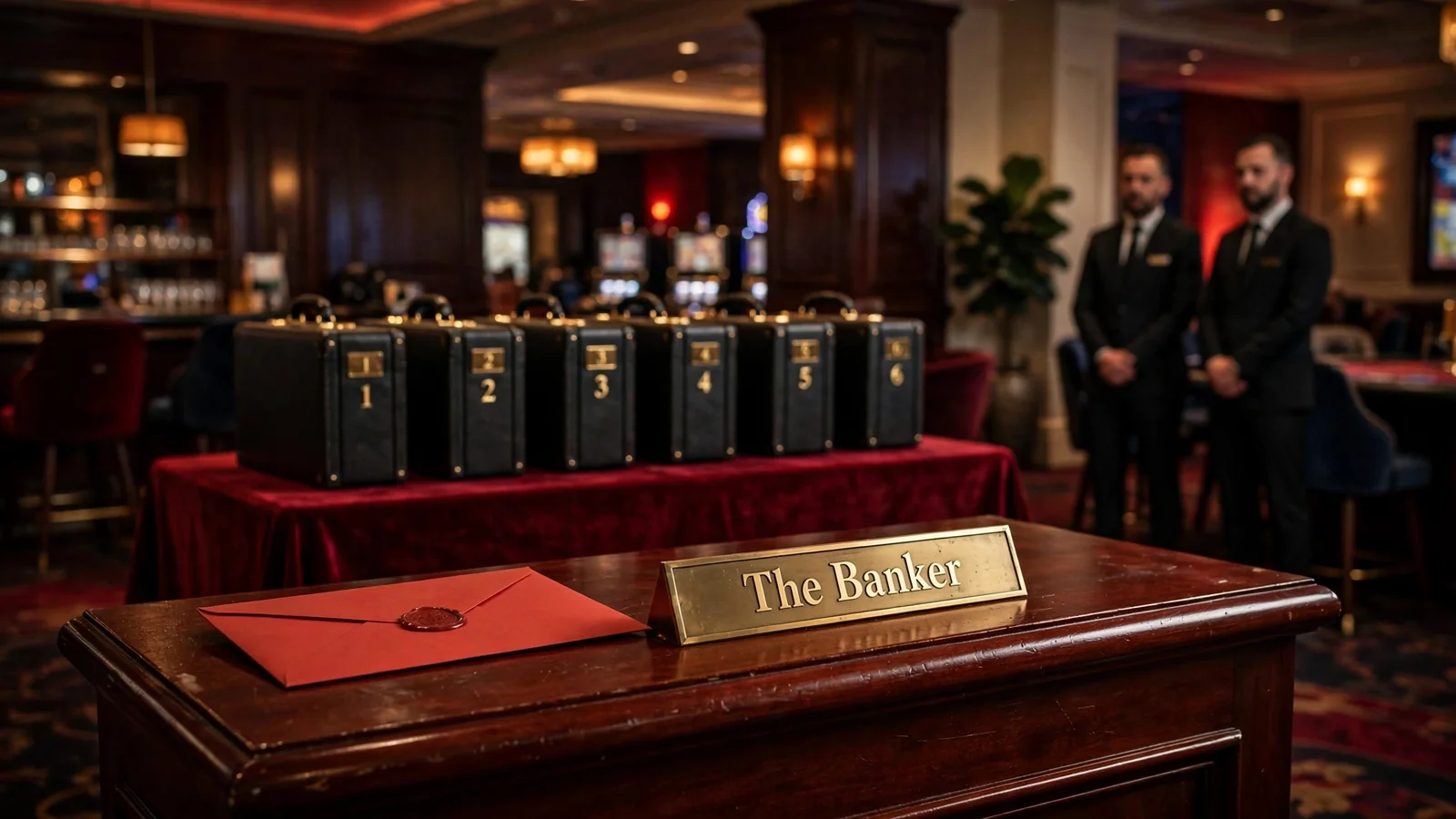
Qualification and Banker-offer rules depend on the specific game, while slot features and free-play options vary by title.
Deal or No Deal in the UK: Qualification and the Banker’s Offer
Deal or No Deal is built around a threshold: a player must qualify before taking part in the game. That requirement matters when a familiar television-style premise appears in a casino setting. The title alone does not establish who can enter, how qualification works or what happens after it. Those details depend on the particular game and the rules attached to it.
The Banker’s offer is another part of the premise, but it should not be treated as a fixed amount or a dependable feature across every Deal or No Deal slot. A specialist review reports that offers can vary substantially because of the random number generator (RNG). That is a report about the game described by that review, not evidence that every version follows the same offer pattern. For a player assessing a specific title, the relevant information is the game’s own rules and how they describe qualification and any offer mechanism.
An offer can sound decisive while remaining a variable part of play. Its presence does not make an outcome predictable, and a reference to the Banker does not by itself explain the financial result of accepting or declining. In practical terms, the name and presentation are packaging; the rules determine what a decision means. Where those rules are not clear before play begins, the premise alone cannot fill the gap.
The same distinction applies to searches for a Deal or No Deal slot in the UK. A television-style name does not establish that a particular title is available at every casino, or that versions with similar branding operate identically. The title identifies a theme, not a complete set of conditions. The operator’s game information should be read as the terms for that specific product, rather than assumed from another game in the same family.
There is also a separate question of which rules govern the casino offering the game. In Great Britain, the UK Gambling Commission is the sole regulator of commercial gambling. Its remit covers remote gambling offered to consumers in Great Britain even when the operator’s key equipment is located elsewhere. Moving servers or other technical infrastructure outside the country does not remove the licensing requirement for an operator selling remote gambling into the British market.
Fast Casino Payouts in the UK: What Can Be Verified
The Commission issues operating licences to gambling businesses and personal licences to individuals who carry out specified operating roles. These are different permissions: the business licence authorises the operator’s activity, while personal licences relate to individuals working in relevant positions. For online casino play, the important distinction is whether the operator holds the appropriate current permission to serve the market, not where its website or equipment happens to be hosted.
The Gambling Act 2005 provides the principal statutory framework for England, Wales and Scotland; it does not apply in Northern Ireland. The Commission’s role described here concerns Great Britain, so the legal position should not be compressed into a claim that one regulator covers every part of the United Kingdom in the same way. For a casino offering aimed at British customers, however, remote operation from abroad is not an exemption from the local licensing regime.
This makes the regulatory check more concrete than a general assurance that a casino is “regulated”. A UK-facing operator should be identifiable as a licensed business, and the licence should correspond to the business offering gambling rather than merely to a software supplier or a game title. The UK Gambling Commission’s public register is the place to verify a licence before funds are deposited. A branded Deal or No Deal game cannot substitute for that operator-level check.
Fast payout online casinos in the UK: withdrawal speed
In Britain, online gambling is legal for adults aged 18 and over when provided by an operator holding a UK Gambling Commission licence. Operators must verify a customer’s age before allowing deposits. The game’s qualification requirement and the account’s eligibility checks are separate gates: one belongs to participation in the game, the other to access to gambling services. Passing one does not establish that the other has been met.
For anyone comparing Deal or No Deal casino options in 2026, the useful order of assessment is therefore straightforward: identify the exact game, read its qualification and offer rules, then establish that the casino serving it is properly licensed for the British market. No general description of the Banker’s offer can replace the rules of the individual title, and no familiar television branding can replace the operator’s licence. A qualifying stage may decide who can enter the game; regulation decides whether the business may offer it to British customers.
Assessment Order
- Identify the exact game title
- Read the specific qualification and offer rules
- Verify the casino’s UK Gambling Commission licence
Top online casinos in the UK
- NightWinBonus: £900 + 400 free spins · Payout speed: 1-3 business days
- Revery PlayBonus: 100% up to€1,000+ 100 FS · Payout speed: 1-3 business days
- ZombillionBonus: Welcome Pack 250% up to £4000 + 200 FS · Payout speed: 1-3 business days
- EvoSpinBonus: 125% up to €2500 + 125 Free Spins · Payout speed: 1-3 business days
- JetsetspinsBonus: 200% Bonus + 100 Free Spins + Free Royal Wheel · Payout speed: 1-3 business days
- NightLuckBonus: Welcome Pack + 805% Up To 6400€ + 280 FS · Payout speed: 1-3 business days
How Deal or No Deal Online Slots Play
The basic structure of a Deal or No Deal slot game is built around symbols, paylines and the result of each spin. The title may recall a familiar television format, but the slot’s ordinary win calculation is based on the symbols shown on its reels. A match has to meet the game’s payline requirement; a near-match or a symbol combination outside the relevant line does not complete a win.
For a winning combination, between two and six identical symbols must land on a payline. The precise arrangement depends on the game’s rules, so the paytable and on-screen instructions are the useful reference points before play begins. They show which symbols count, how they must line up and what the game treats as a completed combination. A title alone does not establish those details.
That distinction matters when comparing different Deal or No Deal online slots. The shared idea of matching symbols does not mean that every game has the same reel layout, payline arrangement or symbol values. Those are game-specific settings, not details that can be inferred from the name. A sensible read of the paytable is therefore more useful than assuming that one version works exactly like another.
What happens after a win
Some games use cascading wins. When a winning combination appears, the symbols involved disappear from the reels and new symbols take their places. Those replacements can create another winning combination, which may then trigger another cascade. The sequence ends when no further qualifying win forms or when the game’s rules otherwise bring that chain to a close.
Keno Casinos in the UK: Picks, Stakes and Payouts
A cascade changes what happens within a spin; it does not make every replacement a winner. Each new arrangement still has to satisfy the game’s payline condition. If the replacement symbols do not create a qualifying combination, the cascade stops. This is a sequence of game outcomes, not a guarantee that one win will lead to another.
For someone looking at a Deal or No Deal video slot, it helps to separate the visual action from the accounting. The reels may change several times following a win, but the relevant result is still the combination that qualifies under the paytable. The display can make a chain of events look continuous; each stage remains subject to the game’s rules.
Autospin and British play
Some game descriptions specify an autospin setting that can queue as many as 100 spins. That does not make the feature available for use in Britain: autoplay is banned for online slots in Britain. An advertised setting and a permitted feature are not the same thing, and a UK-facing game should operate within the applicable rules.
In practice, the legal framework is part of the product, not an optional footnote. Remote gambling operators serving consumers in Great Britain must hold the relevant UK Gambling Commission licence, and the Commission regulates commercial gambling there. The Gambling Act 2005 applies in England, Wales and Scotland; Northern Ireland is outside that Act’s scope. For a British online slot, the rules governing how a spin can be started and what features may be used matter as much as the game’s presentation.
Autoplay Ban
Autoplay is banned for online slots in Britain; any advertised autospin settings are not permitted for use in this market.
The word “autospin” can also be mistaken for a way to change the underlying game. It does not alter the symbol requirement or turn a non-winning arrangement into a win. It refers to automating the start of successive spins, which is precisely why the British restriction is relevant. In the UK, the presence of a setting in a general description should not be read as permission to use it.
Reading the game before staking
The most useful checks are mechanical: which symbols count, how many identical symbols are needed, where they must land, and whether a win can trigger a cascade. Those points explain how a Deal or No Deal online slot game records a result. They do not establish the size or frequency of returns, and no conclusion about either can be drawn from the symbol rules alone.
The label “slot machine” may suggest a physical cabinet, but the same basic concepts apply when the game is presented online: reels display symbols, paylines define qualifying arrangements, and cascades can replace winning symbols with new ones. The exact interface can differ. Instructions shown within the game remain the relevant guide to its particular layout and settlement rules.
A slot’s name is not a substitute for those instructions. Deal or No Deal slots online may share a theme while using different formats, and mechanics from a named variant should not be assumed to apply across every title. The general pattern is narrower: a payline win requires the specified symbol match, and a qualifying win may lead to a cascade. Beyond that, the game’s own rules determine what is counted.
Aviator Casino Game UK: Licensing and Play
For UK play, the feature list should also be read against the rules that apply to the market. Autoplay cannot be used on British online slots, even if a general description mentions a setting for repeated automated spins. Keeping those two points separate avoids confusing a technical description with a permitted way to play.
Deal or No Deal Megaways and Golden Box Megaways
The Megaways name identifies a betting mechanic, not a promise that every spin will produce the same number of winning routes. In Deal or No Deal Megaways, the stated maximum is 117,649 ways to win. That figure describes the mechanic’s upper reach; it is not a prediction of how many ways will be active on a particular spin, nor a measure of the amount returned.
This distinction matters when reading a game listing or review. A maximum ways figure describes possible winning combinations, while an individual result depends on the symbols shown in the game. More ways do not, by themselves, establish a higher return, a better chance of profit or a favourable outcome. Those are separate questions, and the headline number cannot answer them.
Reading the Megaways figure
A useful review should keep the maximum in its proper place. It is a characteristic of the betting mechanic, not a cash value and not a payout guarantee. It also does not state how often the maximum occurs. Treating the number as a likely result would turn a technical description into a forecast, which it is not.
The same care applies to comparisons. A high ways count cannot establish that one game is better value than another without comparable information about other game characteristics. The number is still useful: it tells what the mechanic can offer at its upper limit. It simply does not settle the calculation on its own.
Megaways Mechanic
The maximum figure of 117,649 ways to win describes the mechanic’s upper reach, not a prediction of active ways per spin or a payout guarantee.
The title Deal or No Deal Golden Box Megaways is another named game in this group. The shared Megaways wording identifies the mechanic, while “Golden Box” distinguishes the product title. The name alone does not establish that its rules, payouts or performance match Deal or No Deal Megaways in every respect. Nor does the shared branding justify treating the two as interchangeable in a review.
Reviews, demos and free-play listings
A review of Deal or No Deal Megaways is most useful when it separates the named game from the wider mechanic. The maximum ways figure can be reported accurately, but it should not be used as a substitute for information about returns or likely results. A review title that mentions the game does not, by itself, demonstrate that a particular version or mode is available at a given casino.
The same applies to demo and free-play labels. They describe how a game may be offered, not a separate Megaways mechanic. A listing needs to identify the actual title and the way it can be played; the words “demo” or “free play” alone do not confirm that Deal or No Deal Megaways is available in that form. They also do not turn the maximum ways figure into a measure of value.
Searches that combine Deal or No Deal Megaways with “Golden Box” or “Golden Case” can lead to uncertainty about the title. The confirmed product name is Deal or No Deal Golden Box Megaways. A different phrase in a listing should not be assumed to identify that same game without the title being clear.
Monopoly Live casino in the UK: what a page can prove
Other Deal or No Deal names should likewise be kept distinct. A reference to The Big Hit Megaways or What’s in Your Box? does not establish that the result is Deal or No Deal Megaways or Golden Box Megaways. Similar branding and overlapping wording are not enough to prove that two names refer to the same product. For an accurate comparison, the exact title matters more than a shared phrase.
Playing the Deal or No Deal Slot Machine
“Slot machine” can refer to the game format rather than a physical cabinet. Deal or No Deal slot titles may be presented for online play, but a game name alone does not establish that a particular version is available at a particular casino. Nor does the format say whether a session involves a stake: free access and real-money play are different arrangements.
For real-money play in Great Britain, the relevant check is the operator’s regulatory status, not the familiarity of the game title. The UK Gambling Commission regulates commercial gambling in Great Britain and issues operating licences to businesses. Remote operators selling into the British market must hold the relevant Commission licence, wherever their key equipment is located. A legal online casino serving British players must hold a current operating licence. The licence number can be checked against the Commission’s public register before depositing.
The Gambling Act 2005 governs gambling in England, Scotland and Wales; it does not apply to Northern Ireland. In Great Britain, online gambling is legal for adults aged 18 or over when offered by a UK Gambling Commission-licensed operator. Operators must verify a customer’s age before allowing a deposit. A branded game page does not replace either check: the operator, rather than the game title, is responsible for the account and the gambling service.
Do
- Check the UKGC public register for the operator licence
- Verify age before depositing funds
- Set a financial limit before the first deposit
Don’t
- Use credit cards to fund gambling
- Rely on game branding as proof of regulation
- Expect game cycles to run faster than 2.5 seconds
Online slot play is subject to restrictions that affect how a session can run. Autoplay is not permitted in Britain. Each slot game cycle must last at least 2.5 seconds before the next can begin, so an online version cannot lawfully run spins back-to-back at a faster pace. The stake limit depends on age: the maximum per game cycle is £2 for customers aged 18 to 24 and £5 for customers aged 25 or older. The £5 limit for adults aged 25 and over took effect on 9 April 2025.
Those figures are maximums, not recommended stakes or a description of what any particular game costs to play. The relevant amount is the stake for an individual game cycle. A displayed title, bonus feature or themed interface does not change the applicable cap. Real-money access also sits within broader account rules: remote operators must prompt new customers to set a financial limit before their first deposit and make account-level limit controls available.
Payments are constrained too. UK-licensed casinos cannot accept credit cards for gambling, including where credit-card funds are routed through a money service business. A wallet cannot be used if it permits credit-card money to fund gambling. These restrictions apply to the payment route, not to whether the game is a Deal or No Deal title.
A slot-machine listing should therefore be read as a description of the game, not as proof of its availability, licensing or payment arrangements. Free access is a separate question from staking money; the presence of a game title does not establish that a free version is offered. For a real-money session, the operator’s licence, age checks, stake limits and account controls determine the regulatory conditions.
Live Baccarat Online Casinos in the UK: Licensing
Deal or No Deal Slots in Free Play
“Free play” can mean a version of a slot that can be tried without staking money, but the label alone does not establish that such a version is available for a particular Deal or No Deal game. Availability depends on the operator and the game listing. A title appearing on a casino site is not, by itself, confirmation that it can be opened in a no-stake mode.
Where a genuine practice version is offered, its purpose is limited: it lets a player interact with the game without placing a cash stake. Any balance shown in that mode should not be treated as withdrawable winnings. It is separate from real-money play, where a stake is committed to a game cycle and any resulting balance is subject to the operator’s rules. A screen that looks similar can therefore represent two materially different activities.
The distinction matters for searches to play Deal or No Deal slots online for free. The relevant detail is not simply whether a launch button is marked “free”, but whether the game runs without a real-money stake. A promotional label does not answer that question. The casino’s own game information should make clear whether the option is a practice mode, a real-money game, or another offer with separate conditions.
Free spins are not automatically the same as a free-play version. Spins may be attached to an offer and may still involve eligibility rules or other terms set by the operator. Their presence does not establish that the full game can be tried without wagering, nor that any resulting balance can be withdrawn. The word “free” describes the advertised entry point, not necessarily the complete financial conditions.
Attention: A free-play or practice mode does not serve as evidence that a casino is licensed to provide real-money gambling.
For real-money play in Great Britain, online gambling is legal only through a site holding the relevant UK Gambling Commission licence. The regulator oversees remote gambling offered to consumers in Great Britain, including where the operator’s key equipment is located elsewhere. A practice mode should not be mistaken for evidence that a casino is licensed, and a free-play label does not change the status of real-money gambling on an unlicensed site.
The financial calculation is straightforward: a no-stake session does not expose a cash balance to the game, while real-money play does. That difference does not make a practice version a forecast of real-money results. Nor does it establish that a game will be available in demo form at every licensed casino. Before treating an option as free, the displayed mode and its terms need to be clear.
A search for Deal or No Deal casino free spins can therefore lead to an offer rather than a standalone practice game. Those are separate choices, with separate conditions. The existence of one should not be assumed from the other; where the operator does not state the distinction clearly, the label is not enough to calculate what is being risked.
Deal or No Deal Double Action
Deal or No Deal Double Action is a distinct title, not another name for Deal or No Deal Megaways or Golden Box Megaways. The shared branding does not establish that the games use the same format, features or paytable. Those details need to be tied to the specific Double Action listing rather than inferred from another game in the series.
Casino Dice Games in the UK: Formats and Risks
A useful review of the title depends on the information attached to the exact game: its rules, stake settings, return-to-player figure, features and provider. A casino page using the title is not, by itself, evidence of those specifications. Where rules or figures are shown, they should be checked against the game information displayed by the operator before any real-money play.
The casino offering it matters as much as the title. In Great Britain, a remote operator taking bets from consumers must hold the relevant UK Gambling Commission licence, even if its equipment is based elsewhere. A legal online casino serving British players must have a current operating licence. The Commission’s public register provides a way to check an operator’s licence status; the game name does not substitute for that check.
British online-slot rules also affect the cost of a spin. The maximum stake in a game cycle is £5 for customers aged 25 and over and £2 for those aged 18 to 24. A game cycle must last at least 2.5 seconds before another can begin, and autoplay is prohibited. Operators must verify age before allowing deposits, prompt new customers to set a financial limit before their first deposit, and provide account-level limit controls.
These rules apply to licensed slot play generally; they do not establish any special feature of Double Action. Nor does a shared Deal or No Deal label establish that a particular casino carries this title or provides a particular set of rules. The practical distinction is between a confirmed listing with game information and a title reference without enough detail to assess how the game works. For a review, the latter leaves the central questions unanswered: the name identifies the product, but not its terms of play.
Double Action Rules
- The maximum stake is £5 for adults 25+ and £2 for those 18-24
- Every game cycle must last at least 2.5 seconds
- Autoplay is strictly prohibited in the British market
- Operators must verify age and provide account-level limit controls
What’s in Your Box? Slot: What Can Be Confirmed
What’s in Your Box? is a distinct title within the Deal or No Deal slot family. Its name does not establish how the game works, who provides it or what return it offers.
RTP, or return to player, is a theoretical measure of how much of the total stake a game returns over extended play. It is not a forecast of the result of an individual session, nor a promise that a particular amount will be returned. Even when an RTP figure is stated, it needs to be tied to the specific game version and supported by the game’s information or the operator hosting it. A percentage repeated without that context is not a sound basis for comparing games.
For What’s in Your Box?, the practical position is therefore simple: the title can be identified, but an RTP value should not be assumed. Figures attached to another Deal or No Deal game cannot be transferred to it merely because the names share a brand. Nor does a similar title establish identical rules or payout settings.
In Great Britain, remote gambling operators offering games to consumers must hold the relevant UK Gambling Commission licence. The Commission regulates commercial gambling in Great Britain; Northern Ireland is outside the scope of the Gambling Act 2005. A licensed operator’s status is a separate question from a game’s RTP: a valid licence does not, by itself, confirm a particular return percentage.
Where a game’s information displays an RTP, that figure should be checked against the exact title and version shown. If no figure is displayed, there is no reliable percentage to use in a calculation. Treating an unconfirmed number as a known return would make the arithmetic look precise while leaving its central input unsettled.
Live Blackjack Online Casinos in the UK: What to Check
The Perfect Play Slot
The Perfect Play is a distinct Deal or No Deal title, not another name for Double Action or What’s in Your Box?. A shared brand does not establish shared rules. The title alone does not confirm its provider, return to player, volatility, bonus features or availability at any particular casino, so those details should not be inferred from other games in the series.
That distinction matters when a casino listing uses a shortened name or groups several branded games together. A listing should identify the actual game being offered. If its information does not match the title shown in the game, the mismatch is a reason to pause rather than assume that features from a similarly named slot apply.
For real-money play in Great Britain, the operator must hold a relevant UK Gambling Commission operating licence. The Commission regulates remote gambling offered to consumers in Great Britain, including where the operator’s key equipment is located elsewhere. A casino’s description of The Perfect Play does not replace checking the operator’s licence on the Commission’s public register.
UK rules also affect the cost of each online slot game cycle. The maximum stake is £2 per cycle for customers aged 18 to 24 and £5 for customers aged 25 or over. The lower limit applies by age; the higher limit is not a general allowance for every customer. Operators must verify age before allowing a customer to deposit, and the minimum interval between game cycles is 2.5 seconds.
These rules describe the regulated setting, not the individual slot. They do not confirm that The Perfect Play is available at a particular licensed casino, nor do they establish its payout figures or special features. Those details need to be checked against the specific game and operator listing rather than borrowed from Deal or No Deal Megaways or another title.
Stake Limit Details
Stake limits for online slots in the UK are determined by age: customers aged 18 to 24 are limited to £2 per game cycle, while those aged 25 or older have a maximum limit of £5 per cycle (effective 9 April 2025).
The practical distinction is simple: the name identifies a game, but it is not evidence of its terms or performance. Any decision involving a real-money version depends on the exact game displayed and the licensed operator providing it. The brand label does not settle either point.
No-Deposit Bonus Searches: Terms Must Be Verified
A no-deposit bonus is an offer that does not require an initial cash deposit, but the label alone says little about its financial value. A Deal or No Deal title in an offer description would not, by itself, establish who can claim it, which game qualifies or what conditions apply. Those details belong to the operator’s published terms.
Before treating an offer as usable, the relevant checks are its eligibility rules, any wagering requirement, expiry date, permitted games and withdrawal conditions. Each changes the amount that can ultimately be withdrawn, or whether withdrawal is possible at all. If any of those terms cannot be located or understood, the headline value is not a reliable basis for comparison.
The legal position is separate from the promotion. Online gambling in Great Britain is lawful only through a site holding the appropriate UK Gambling Commission operating licence. The Commission regulates remote gambling offered to consumers in Great Britain even when the operator’s key equipment is elsewhere. A bonus advertised by a site outside that system is not made compliant by mentioning a familiar television or game title.
Age and account checks also matter. Operators must verify a customer’s age before allowing a deposit, and remote operators must prompt new customers to set a financial limit before their first deposit while providing account-level controls. Those requirements do not establish that any particular promotion is available or suitable.
A proper comparison therefore starts with the operator’s terms, not the bonus headline: the qualifying account, applicable game, playthrough conditions, deadline and cash-out rules must all be stated. Any unclear term leaves the offer’s final value uncertain. That is a calculation problem, not a bonus feature.
French Roulette Online Casinos in the UK: Rules & Bets
Deal or No Deal Scratchcards
A Deal or No Deal scratchcard is a different product from a Deal or No Deal online slot. The shared title does not establish that they have the same rules, prizes or way of playing. Nor does the existence of online slot games with the brand confirm that a scratchcard version is currently offered in the UK.
The distinction matters because the legal framework depends on the activity being offered, not simply on its name. In Great Britain, commercial gambling is regulated by the UK Gambling Commission. A remote operator selling gambling to customers in England, Scotland or Wales must hold the relevant Commission licence, even if its business or equipment is based elsewhere. The Gambling Act 2005 governs gambling in those three nations; it does not govern Northern Ireland.
If a scratchcard is presented as an online gambling product, its operator and the nature of the product need to be considered under the applicable rules. A familiar television-game title is not evidence of approval, availability or a particular prize arrangement. The brand name is not a rulebook.
This also separates scratchcards from online slots in practical terms. A slot’s format or branded features cannot be assumed to apply to a scratchcard, and slot-specific information should not be used to calculate the cost or potential return of another product. Any decision involving real-money gambling depends on the actual product terms and the operator’s regulatory status, rather than similarities in the title.
In the UK, online gambling is legal for adults aged eighteen and over when it is offered by a site holding a UK Gambling Commission licence. That framework provides a clear reference point for checking whether an online gambling service is authorised. It does not, by itself, establish that a particular Deal or No Deal scratchcard is available or specify how it works. A scratchcard should therefore be assessed as its own product, not treated as another version of the slot.