
 Available in GB
Content
- Craps Rules and the Flow of a Round
- Playing Craps Online for Real Money
- Craps at UK Online Casinos: Regulatory Scope
- Assessing an Online Casino for Craps
- Craps Betting Options and Table Layout
- Free Craps and Bubble-Style Play
- Live-Dealer Craps and Cryptocurrency Searches
- How the Craps House Edge Is Assessed
- What the Odds of Winning Mean in Craps
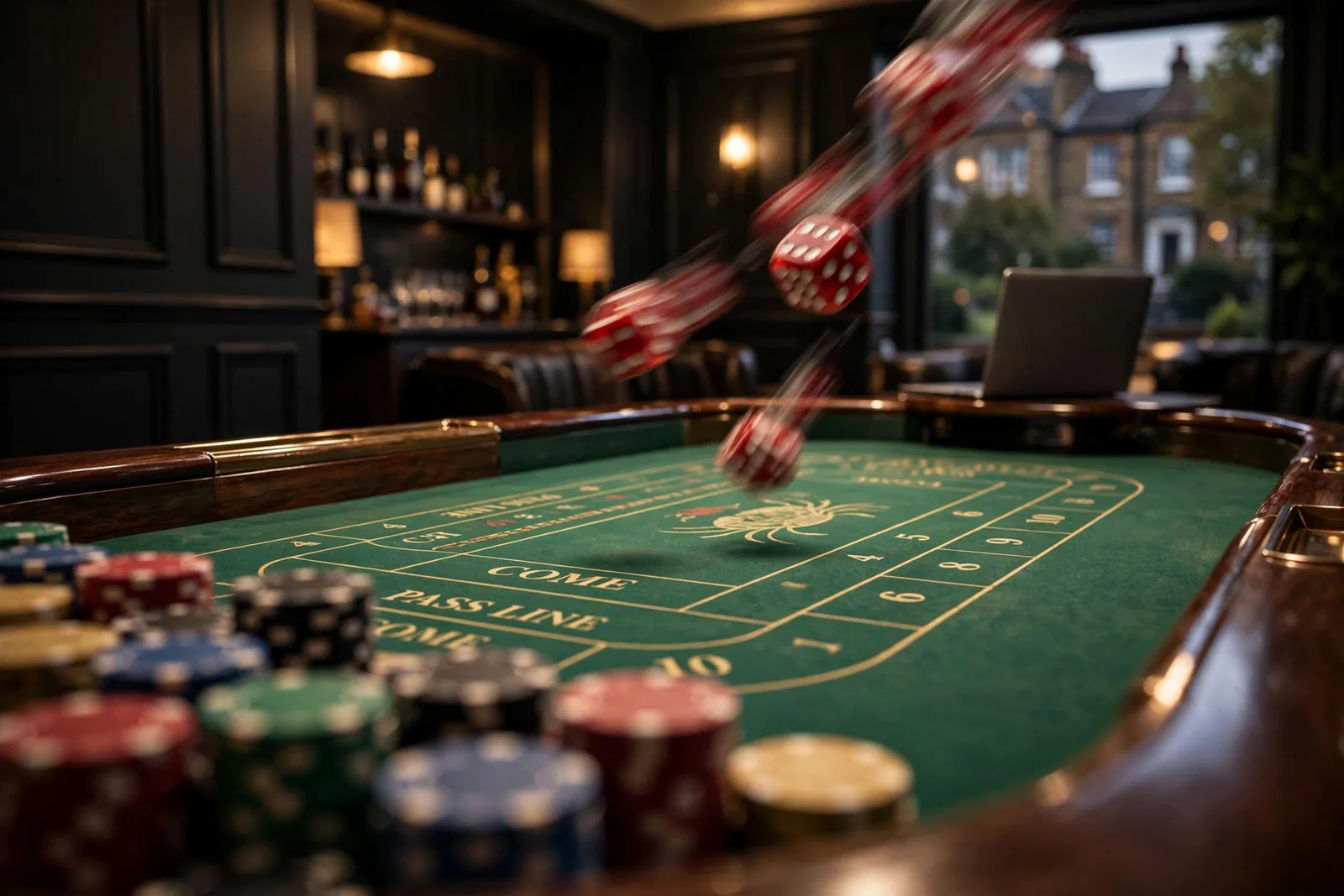
Follow how come-out rolls, points and seven determine pass-line bets, alongside factors for assessing online craps tables.
Craps Rules and the Flow of a Round
Craps is played with dice, and the central sequence is called a round. One player, known as the shooter, rolls while the other players choose wagers on the outcome. The round begins with a come-out roll. Its result either settles certain bets immediately or establishes a point that must be resolved by later rolls.
On the come-out roll, a pass-line bet wins if the dice show a natural: a total of seven or eleven. A total of two, three or twelve is called craps, and the pass-line bet loses. Any other total becomes the point. The dealer marks that point on the table so it remains clear which result the shooter is trying to repeat.
Once a point is established, the shooter continues rolling. If the point appears again before a seven, the pass-line bet wins and the round ends. If seven appears first, the pass-line bet loses and the round ends. This is the point phase: the relevant comparison is between repeating the marked total and rolling seven.
Best Novomatic Online Casinos UK: Amatic Guide
A new come-out roll starts the next round, and the shooter may change as play proceeds according to the table’s procedure. The labels describe different parts of the same sequence: “come-out” means the opening roll, “point” is the total set during that roll, and “seven out” means a seven has ended the point phase before the point was repeated.
The pass line is the basic wager that follows this sequence, but it is not the only possible bet. Other wagers can concern particular totals or events during a round. Their timing and settlement depend on the bet selected, so the pass-line sequence should not be treated as a complete explanation of every option.
For a first reading of a craps game, the useful distinction is between the opening roll and the point phase. The opening roll may settle the pass line or set a point; after that, the round continues until the point is repeated or a seven ends it. The same terms make the game’s progress legible whether the dice are rolled by a player or represented on screen.
EGT Online Casinos in the UK: Licensing and Slot Checks
Top online casinos in the UK
- NightWinBonus: £900 + 400 free spins · Payout speed: 1-3 business days
- Revery PlayBonus: 100% up to€1,000+ 100 FS · Payout speed: 1-3 business days
- ZombillionBonus: Welcome Pack 250% up to £4000 + 200 FS · Payout speed: 1-3 business days
- EvoSpinBonus: 125% up to €2500 + 125 Free Spins · Payout speed: 1-3 business days
- JetsetspinsBonus: 200% Bonus + 100 Free Spins + Free Royal Wheel · Payout speed: 1-3 business days
- NightLuckBonus: Welcome Pack + 805% Up To 6400€ + 280 FS · Payout speed: 1-3 business days
Playing Craps Online for Real Money
Real-money online craps combines two separate systems: the game, which determines the result of a round, and the casino account, which records the money available for play and any resulting credit. The distinction matters. A dice result belongs to the game; deposits, withdrawals and account balance belong to the operator’s cashier and account system.
In a real-money session, a player chooses a stake from the balance available in the casino account and places it through the game interface. The game processes the round, displays its outcome and calculates any return under the bets placed. The account then reflects the resulting change. A winning result does not itself move money to a bank account: it changes the casino balance, which remains subject to the operator’s account and withdrawal procedures.
That flow is different from trying a game without real stakes. In a practice mode, displayed credits are not necessarily money that can be withdrawn. A real-money balance represents funds held for gambling, while a practice balance is a way to interact with a game without treating its displayed total as cash. The label and terms attached to a mode therefore matter more than the visual similarity between two versions of a game.
The account sits outside the game
The game interface may show a balance, stake controls and round results, but those features do not make it the holder of the funds. The casino account is the financial record associated with the customer. It is where money is credited for play and where any winnings are recorded before a withdrawal is requested. The casino operator, rather than the game itself, is responsible for account administration, deposit handling, payouts, bonus terms and customer support.
This division also affects where a balance dispute belongs. A question about how a round was settled concerns the game result; a question about a missing deposit, an account balance or a withdrawal concerns the operator’s account records. The two systems interact, but they are not interchangeable. A game screen can report a result without explaining every step in the movement of funds through the casino account.
Attention: The casino account is the financial record associated with the customer, not the game interface itself; the operator, not the software provider, is responsible for deposits, payouts, and account administration.
For the same reason, a game provider’s name should not be mistaken for the name of the business holding a player’s money. A software supplier can create or distribute games without operating a consumer casino or accepting bets directly. The casino account is opened with the operator, and its terms govern the financial relationship.
What “real money” changes
The basic game sequence does not become a different kind of dice game merely because the stakes are monetary. What changes is the consequence attached to each decision: the stake is deducted or committed through the account, and a settled return can affect the balance. The amount at risk is therefore the amount actually attached to the selected wager, not every figure displayed elsewhere on the screen.
A displayed balance is not the same as a guaranteed withdrawal amount. It may include funds subject to conditions, such as a bonus balance or a promotion with separate terms. Those conditions can affect whether funds are available for withdrawal and what must happen before they can be withdrawn. A cash balance and promotional funds should not be treated as equivalent merely because both appear in an account.
The same care applies to a game’s controls. A button that confirms a wager is part of the game interaction; it does not explain the cashier’s rules, the status of a deposit or the conditions for withdrawing a credited return. Those details sit in the account terms. Understanding the screen and understanding the account are separate tasks.
Checking the financial record
A useful way to follow a real-money session is to separate its entries: funds added to the account, stakes placed, round results, any promotional credit, and withdrawals requested or completed. The game history can help explain individual rounds, while the account history records financial movements. If the displayed figures do not match, the relevant records are those for the part of the process in question.
Quickspin Casinos in the UK: What to Verify
No particular deposit route, withdrawal speed, minimum transaction or craps-specific account condition can be assumed across casinos. Those are operator terms, not inherent properties of craps. The practical comparison is therefore between the exact account conditions attached to a casino and the way its game settles a round, rather than between interface labels alone.
Real-money craps is consequently not just a game with a cash figure on screen. It is a sequence linking a casino account, a wager, a game result and an account entry. Keeping those stages distinct makes the financial meaning of a round clearer without confusing the software that runs it with the business that holds the balance.
Craps at UK Online Casinos: Regulatory Scope
A casino’s location is not, by itself, what determines whether its remote gambling is within the British regulatory system. The relevant question is whether the operator offers remote gambling to consumers in Great Britain. The UK Gambling Commission’s remit applies to that activity even when the equipment used to run the service is based elsewhere. A business cannot avoid the British licensing requirement simply by placing its servers or other key equipment abroad.
This distinction matters when considering a casino that appears to accept British customers. A site may be reachable from Great Britain without being authorised to provide gambling there. Remote operators serving the British market must hold the relevant UKGC licence, and online gambling is legal in Great Britain only through a licensed and regulated operator. A foreign address or a working registration page does not establish that status.
Licensing Requirement
Online gambling is legal in Great Britain only through a licensed and regulated operator holding a relevant UKGC licence.
The Commission regulates commercial gambling in Great Britain as the sole regulator for that activity. Its remit includes online casinos, so a casino offering remote games to British consumers falls within the same broad oversight framework as other commercial gambling operators. The regulator’s role is not limited to the location of a game or the device on which it is played; it concerns the operator’s provision of gambling to the market.
What a licence applies to
The UKGC issues operating licences to businesses and personal licences to individuals who perform relevant roles in gambling operations. These are different forms of authorisation. The operating licence concerns the business providing gambling, while a personal licence applies to an individual. A reference to a licensed company should therefore not be confused with an individual’s licence, or treated as proof that every person associated with a casino holds one.
For an online casino, the operator’s licence is the central point in assessing whether it may legally serve customers in Great Britain. The presence of a particular game, software supplier or brand does not replace that requirement. Nor does a supplier’s status establish that every website carrying its software is authorised. The company providing the consumer-facing gambling service remains the relevant business to identify.
The rules also distinguish Great Britain from the whole United Kingdom. The Gambling Act 2005 provides the main legislative framework for gambling in England, Wales and Scotland; Northern Ireland is outside that Act’s scope. For that reason, references to the UKGC’s remote-gambling remit should be understood in relation to Great Britain, rather than assumed to describe a single licensing arrangement covering every part of the UK.
Betsoft Online Casinos in the UK: Operator Roles
Applying the boundary to a casino
The phrase “online casino with craps” describes a game and a service, not a regulatory status. The presence of craps on a site would not, on its own, show that the site can lawfully offer it to customers in Great Britain. Regulatory status depends on the business offering the gambling and whether it holds the required UKGC licence. These are separate checks: a game catalogue says what may be available, while an operating licence concerns the legal basis for serving the market.
Likewise, the absence of a UK address does not remove an operator from the British framework if it offers remote gambling to consumers in Great Britain. The Commission’s reach is tied to the market served, not simply to where the operator or technical equipment is situated. That is the practical reason an offshore location should not be treated as an exemption from the licensing requirement.
A UKGC licence is also not a guarantee that every individual game is available at every licensed casino. It identifies the operator’s regulatory authorisation, not the contents of a particular lobby. Availability and licensing answer different questions and should not be collapsed into one claim.
For a British-facing casino, the regulatory baseline is therefore straightforward: identify the business providing the service and establish whether it holds the relevant UKGC operating licence. The regulator’s jurisdiction over remote gambling offered to Great Britain consumers does not depend on where the key equipment sits. A casino’s presentation, game names or technical arrangements cannot substitute for the operator’s authorisation.
Regulatory Baseline
- Identify the business providing the service
- Establish if the business holds a UKGC operating licence
- Understand that licensing applies to the market served, regardless of equipment location
- Recognize that a UKGC licence identifies the operator, not the specific game catalogue
Assessing an Online Casino for Craps
A useful craps shortlist has to establish one thing before comparing anything else: whether the casino actually offers craps to its customers in the United Kingdom. A familiar brand, a large game catalogue or a general casino licence does not by itself demonstrate that a craps game is available. Those are separate facts, and treating them as interchangeable would produce a recommendation without the feature the recommendation is meant to assess.
A ranked list of named casinos would imply current, operator-specific availability. Without that evidence, calling one the best online casino for craps would be packaging rather than an assessment.
What counts as evidence of availability
The relevant evidence is an operator’s own current game listing or lobby entry for craps. The title should be identifiable as a craps game, rather than inferred from a general reference to table games, dice games or a software supplier’s catalogue. A supplier may make games available to casino businesses, but that does not show that a particular casino carries a particular title or makes it accessible to its UK customers.
Availability can also depend on the operator’s own catalogue and arrangements. A game appearing on a provider’s website, in a third-party directory or in a list of games associated with casinos is not conclusive evidence that it can be opened at a specific operator. The distinction is basic but commercially important: a supplier’s product range is not the same thing as a casino’s active offering.
A casino’s own listing should therefore be checked at the point a recommendation is made. The game needs to appear as an available title in the operator’s environment, not merely in an old article or an undated directory. If the operator’s listing does not show craps, its other qualities cannot fill that gap. A strong general reputation is not evidence of a missing game.
BGaming Casinos in the UK: What the Evidence Shows
What a “best” comparison can and cannot mean
Once availability is established, “best” needs a defined basis. For a craps-focused comparison, the first criterion is straightforward: the operator must offer craps to UK customers. Only then can other features be compared, such as how clearly the game is presented or how readily its rules and conditions can be found. Without that first criterion, a ranking measures general casino appeal rather than suitability for craps.
The distinction also prevents misleading substitutions. A casino may offer other table games, a broad selection of slots or games from a recognised supplier, yet none of those facts proves that it has craps. Nor does a provider’s general range establish the exact titles carried by each operator. A recommendation should match the product named in its heading; otherwise, the comparison answers a different question.
There is no defensible “best” operator ranking without confirmed craps availability for each candidate. That does not mean every casino should be treated as equivalent. It means the comparison cannot start until the defining feature is evidenced. Where it is not, the accurate result is an unranked field, not a speculative list dressed up as consumer guidance.
Keeping the check current
Casino catalogues can change, so an old mention of craps should not be treated as proof of present availability. A listing should be current and attributable to the casino itself. If a title is absent from the operator’s own catalogue, an outside reference alone does not establish that the game can be played there. If the title is listed, its availability should still be considered specific to that operator rather than assumed to apply across other casinos using the same supplier.
Do
- Check the operator’s own current game listing
- Verify the game is identifiable as craps
- Use current evidence attributable to the casino
Don’t
- Rely on a general reference to table games
- Assume availability based on a supplier’s catalogue
- Trust old articles or undated directories
This standard is deliberately narrower than judging a casino overall. It does not assess the mechanics of craps, compare individual bets or calculate game odds. Those questions depend on the particular game and its rules. The immediate selection issue is more basic: whether the casino offers the game at all, and whether that claim rests on operator-specific evidence.
The phrase “best craps casino” therefore has a precise burden of proof. A casino must first be shown to offer craps to UK customers; only then can it be compared with another confirmed option. Without that evidence, naming winners would create certainty that the underlying availability does not support.
Craps Betting Options and Table Layout
A craps table layout is a map of the wagers a game accepts. It is not just decoration: each marked area corresponds to a betting choice, and placing a chip in the wrong area can change the wager being made. For an online version, the same principle applies even if the layout is adapted for a screen. The displayed labels and the game’s help information are the basis for identifying what a selection means; assumptions based on another table or another game are not a reliable substitute.
The betting area should be read before chips are committed. Labels indicate where a wager belongs, while the game’s rules explain when it can be placed, how long it remains active and what event settles it. Those details determine the practical difference between choices. Two wagers shown close together may have different conditions, and a familiar name does not establish that every game applies the same rules or interface behaviour.
Read the selection, not the graphic
A craps layout can present several choices at once. Its arrangement may group wagers by their role in a round, but the position of a button or marked region alone does not explain the terms. A useful review separates three questions:
- What event or condition does the wager depend on?
- When can it be selected, changed or removed?
- When is its result determined and any payout credited?
These are questions about the wager’s operation, not about which option is preferable. The displayed rules should answer them. If the game does not make a condition clear, the selection should not be treated as understood merely because its label is recognisable.
Online controls can make placement appear simpler than it is. A chip may be selected and then assigned to a marked area, or a control may represent a wager directly; the exact method depends on the game. Before confirming, the interface should make clear both the selected amount and the area receiving it. A tap near a boundary or a repeated click can otherwise produce a different stake from the one intended. The confirmation display, where provided, is a practical check on the transaction.
Separate the wager from its presentation
The layout is a visual guide, but the rules attached to a selection carry the financial meaning. A clear assessment records the wager’s required condition, its timing and the way the game handles a result. It also distinguishes an active wager from one that has been resolved or removed. Without those distinctions, the visual display can be easy to follow while the underlying commitment remains unclear.
Before Placing a Wager
- Read the betting area labels
- Review the game’s rules for the specific selection
- Verify the selected stake amount
- Confirm the marked area receiving the chip
The same caution applies to controls for repeating or adjusting a selection. A repeat function may reproduce a previous choice, while an adjustment control may alter a stake or a placement. Neither label should be assumed to mean more than its stated function. The game’s help panel or rules should explain what the control does and whether it changes the current decision or prepares a later one. In money terms, the relevant amount is the stake actually confirmed, not the amount a player intended to enter.
A sensible way to approach a new layout is to inspect the available information before selecting anything. Identify the wager areas, open the rules for unfamiliar labels, and check how the interface shows a selection before confirming it. If the game does not explain how a wager is settled or how the controls affect it, that is a material gap in understanding, not a reason to infer the answer from the graphics.
What a layout can and cannot establish
A table graphic can show that a choice is offered in that particular game. It cannot, by itself, establish the full rules, the financial outcome of every possible result, or whether the same choice works identically elsewhere. Those points belong to the game’s published rules and displayed terms. A named option may be familiar, but familiarity is not a substitute for checking the version in front of the player.
Elk Studios Casinos in the UK: What to Check
This matters when comparing games as well as when playing one. Differences in terminology, placement controls or explanations can affect how readily a wager is understood. A comparison should therefore focus on whether the rules define each option and whether the interface makes a confirmed selection visible. A crowded or stylised layout is not automatically a problem; unclear terms are. Conversely, a clean design does not prove that a wager’s conditions are simple.
There is no universal “best way” to use a layout independent of the rules and the intended stake. A method that relies on remembering where a choice appeared in another game risks misplacing a wager. The more dependable approach is procedural: read the displayed definition, make one selection at a time, verify the confirmed area and amount, and review the settlement information when the result is shown. That keeps the decision tied to the actual game rather than to an assumed table convention.
The layout also should not be used as a shortcut for judging the cost or likelihood of a wager. Those are separate questions requiring the relevant rules and mathematical information. A prominent area, a large button or a visually central position says nothing reliable about value. Keeping presentation, operating conditions and financial assessment distinct prevents a graphic from doing work it cannot do.
For an online craps game, the practical test is whether the table makes the available choices legible and the rules behind them accessible. Each selection should be traceable from its label to its conditions, from placement to confirmation, and from the round’s outcome to settlement. Where that chain is clear, the layout can help organise decisions. Where it is not, the visual map is insufficient, regardless of how familiar the table may look.
A table graphic confirms a choice is offered but does not establish the full rules or financial outcomes; these must be verified in the published rules and displayed terms.
Free Craps and Bubble-Style Play
Free play and bubble-style craps are related searches, but they describe different things. Free play concerns whether a game can be tried without staking cash. “Bubble craps” is a label for a style or format of craps; the name alone does not establish how a particular game works, whether it is available in Britain, or whether it can be played for free.
A free game, where one is offered, may be useful for learning how its interface presents a round and how selections are entered. It does not establish that the same title is available for real-money play, that its settings match another version, or that any simulated outcome predicts a later result. Free access also needs to be distinguished from promotional funds: a demonstration mode and a bonus balance can have different terms and consequences. The word “free” is not a complete description of the arrangement.
The same care applies to bubble-style play. A casino’s label should be checked against the actual game information, rather than treated as evidence of a particular layout, automated process or betting menu. Those details determine what the format offers; the name by itself does not. Without clear product information, it is not possible to compare bubble craps with a conventional table presentation on mechanics or access.
Availability is a separate question from terminology. A listing, search result or category label is not enough to establish that a UK-facing casino currently offers a craps game, in free mode or otherwise. A game page should identify the title and show whether it opens in a demonstration mode, requires an account, or involves a real-money balance. If those conditions are unclear, the practical value of the listing is unclear too.
Habanero Online Casinos in the UK: Games & Rules
For a no-cash trial, the relevant point is whether the game can be opened without depositing or committing funds, and whether the displayed mode is genuinely a demonstration rather than a bonus offer with conditions. For bubble-style play, the relevant point is the game’s own description and controls, not the label used in a menu or advert. Neither term guarantees that a suitable option exists.
These distinctions keep free practice separate from casino availability and promotional terms. A familiar name can describe an intended format, but only the game’s own presentation establishes what is actually being offered. Until that is clear, neither free craps nor bubble craps should be treated as a confirmed UK casino product.
Live-Dealer Craps and Cryptocurrency Searches
Interest in live-dealer craps and interest in paying with cryptocurrency are separate questions. A live table describes how a game is presented; Bitcoin or another cryptocurrency describes a payment method. Seeing both terms in a casino’s marketing does not establish that the game is available to customers in Britain or that the operator is authorised to serve them.
For remote gambling offered to consumers in Great Britain, the operator must hold a UKGC licence, regardless of where its equipment is located. A cryptocurrency payment option does not replace that requirement or bring an offshore casino within the UK regulatory system. Offshore casinos operate outside that system, so their presence online should not be read as evidence of UKGC oversight or access to UK regulatory protections.
Attention: A cryptocurrency payment option does not replace the requirement for a UKGC licence nor does it bring an offshore casino within the British regulatory system.
The same distinction applies when a search combines live craps with dice games, a particular table format, or crypto payments. Each is a separate product or service claim. A page may describe a table as live, list dice games, or display a cryptocurrency logo, but those details alone do not establish that all the features are available together to a UK customer. Nor does a description of a craps layout prove that a live dealer is involved.
The relevant assessment is therefore not whether a casino uses the word “crypto” or depicts a live table. It is whether the operator holds the required UKGC licence for serving the market and whether the specific game and payment method are actually offered under its terms. Those are distinct checks; one cannot be inferred from the other.
A “best” label adds no useful evidence by itself. Without substantiated information about UK availability, live-craps promotion and cryptocurrency acceptance should not be treated as a verified combination. Offshore status is not a substitute for a local licence, and a casino’s payment branding does not alter where its regulatory responsibilities lie.
Wazdan Casinos in the UK: Games, Licensing and Checks
How the Craps House Edge Is Assessed
The house edge describes the casino’s theoretical advantage over repeated play, not the outcome of an individual round. In craps, it cannot be treated as one fixed figure for the whole game: each wager has its own terms, and the calculation depends on the chance of each result and the payout attached to it.
The basic comparison is between what a wager pays when it wins and how often its possible outcomes occur. If the payout is less generous than the probability of winning would imply in a fair game, the difference creates an expected advantage for the house. The precise result therefore depends on the rules and paytable of the version being played, as well as the specific wager being assessed.
A casino’s general description of craps is not enough to establish a house edge. The relevant information is the game’s stated rules and the payout for each available bet. Without those details, a single figure may describe a different wager or a different version of the game. Treating it as universal would make the comparison unreliable.
Amatic Online Casinos in the UK: How Games Are Supplied
For online craps, the same distinction applies: the game’s presentation does not determine the calculation. The payout terms do. House edge is useful for comparing the long-run cost built into wagers, but it does not predict the result of a particular session. That is a separate question from the probability of winning a specific bet.
What the Odds of Winning Mean in Craps
The odds of winning at craps describe the likelihood of a particular outcome, but “winning” needs a clear definition. It could mean that a bet pays out, that a round ends with a net gain, or that a player finishes a session ahead. Those are different measures, and none can be inferred from a game’s name alone.
A bet’s chance of winning is not the same as its long-run cost. The house edge describes the casino’s mathematical advantage across repeated play, while the chance of winning concerns the outcome of a defined bet or event. A wager can win relatively often and still return less over time than it costs; another can win less often but pay more when successful. The terms answer separate questions.
IGT Online Casinos in the UK: Licensing and Games
The payout also matters when calculating whether a result leaves a net gain. A winning bet does not necessarily mean that the whole round was profitable if other bets lost. Likewise, a result that returns a stake is not equivalent to a profit. Comparing odds without specifying the bet, payout and treatment of returned stakes produces an incomplete figure.
No single probability applies to every craps wager, and an overall “chance of winning craps” can therefore mislead. A meaningful figure must identify exactly what is being counted and over what scope. Without that definition, a headline percentage cannot show the likely result of a particular bet or establish how the game compares with another. The distinction is accounting, not wording: probability measures outcomes; house edge measures the casino’s advantage over repeated play.